
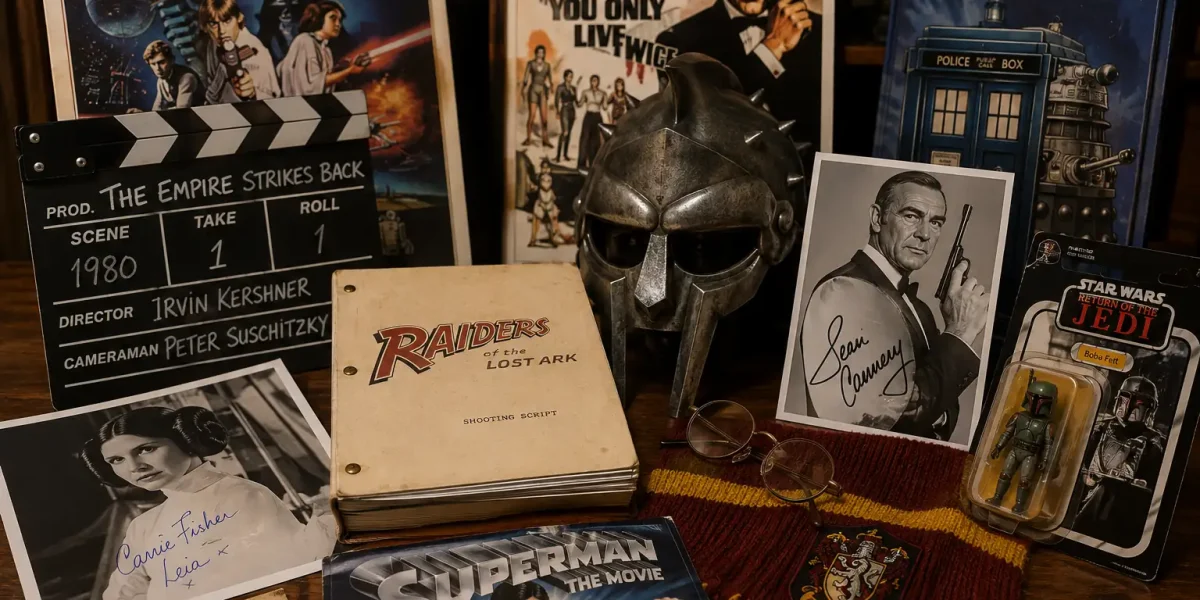
Film and television memorabilia is one of those collecting hobbies that can start very easily. You buy an old cinema poster from a favourite film, find a Doctor Who annual at a car boot sale or pick up a signed photograph, and before long you’re looking at original scripts, props and production-used costumes.
For UK collectors, there is an enormous amount to choose from. Britain has more than a century of film history and over 70 years of mainstream television heritage, from Hammer Horror, James Bond and Carry On films to Doctor Who, Only Fools and Horses, Thunderbirds, Star Wars, Harry Potter and countless cult programmes and productions.
The BFI National Archive itself preserves one of the world’s most important collections of film and television, including films, television programmes, posters, photographs, scripts, production designs and other material associated with screen history.
You certainly don’t need a museum-sized budget to start collecting. Some fascinating pieces of film and television history can still be bought for relatively modest amounts. The important thing is learning what you are buying, understanding the difference between original and reproduction material, and resisting the temptation to buy something simply because a seller describes it as “rare”.
Here are our tips for getting started.
What Counts as Film and TV Memorabilia?
Film and television memorabilia covers almost anything associated with the production, promotion, release or cultural history of a film or television programme.
That makes it an unusually broad collecting category.
You might collect:
- Original cinema posters
- Lobby cards and cinema publicity material
- Production-used props
- Screen-worn costumes
- Original and production-used scripts
- Call sheets and production documents
- Storyboards and concept artwork
- Autographs and signed photographs
- Press photographs and promotional stills
- Film programmes and brochures
- Tickets and cinema ephemera
- Original animation cels
- Vintage toys and merchandise
- VHS tapes, DVDs and other physical releases
- Magazines, annuals and books
The BFI’s own archive collections demonstrate just how varied screen-related material can be, incorporating everything from film and television footage to still images, posters, designs, books, journals and personal papers.
1. Start by Collecting Something You Actually Like
It sounds obvious, but it is probably the most useful advice for a beginner.
Don’t begin by asking, “What film memorabilia will increase in value?” Start by asking what you would actually enjoy owning.
If you grew up watching Doctor Who, start there. If you love James Bond films, concentrate on Bond. If your interest is British comedy, you might prefer memorabilia connected with Only Fools and Horses, Dad’s Army, Blackadder or Monty Python.
A focused collection is usually much more satisfying than a random assortment of objects bought because somebody said they were collectable.
You can narrow a collection by:
- A particular film or television series
- An actor or director
- A production company or studio
- A particular genre, such as horror or science fiction
- A decade
- British cinema or television specifically
- One type of item, such as posters, scripts or props
Having a theme also makes research considerably easier. After following one particular area for a while, you begin recognising what is common, what is unusual and what simply doesn’t look right.
2. Learn the Difference Between Memorabilia, Merchandise and Production Material
One of the first things a new collector should understand is that not everything associated with a film was actually involved in making it.
A commercially produced Star Wars toy from 1978 is genuine vintage film memorabilia, for example, but it is not a production-used prop.
Likewise, an original cinema poster advertising a film is an authentic piece of promotional memorabilia, but it never appeared on screen.
Production material is different. It can include objects specifically created or used during filming, such as:
- Screen-used props
- Production-made props
- Screen-worn costumes
- Scripts issued to cast or crew
- Call sheets
- Production photographs
- Concept artwork
- Storyboards
- Clapperboards
- Models and miniatures
The distinction matters because the values can be completely different.
3. Understand What “Screen-Used” Actually Means
“Screen-used” is one of the most important phrases in film memorabilia collecting, but it should not be accepted without evidence.
In its straightforward sense, a screen-used item is something that was actually used during filming. Ideally, it can be matched to a particular scene, actor or moment on screen.
You may also encounter descriptions such as production-used, production-made, hero prop, stunt prop and background prop.
Hero props
A hero prop is generally a detailed version intended for close-up use or significant interaction with a principal performer. Multiple versions of the same object may have been created.
Stunt props
Stunt versions may be lighter, softer or constructed differently so that they can be used safely during action sequences.
Production-made props
A production-made item was created for the production, but that does not necessarily prove it appeared in the final film or television programme.
That distinction is important. A genuine production-made object can still be highly collectable, but it should not automatically be described or priced as screen-used.
4. Provenance Is Everything When Buying Props
If you’re spending serious money on film memorabilia, the story behind an item is not enough. You want evidence.
Provenance is the documented history showing where an item came from and, ideally, how it can be connected to the production.
Useful provenance might include:
- Documentation from the production company
- Studio inventory labels
- Letters from cast or crew
- Original auction paperwork
- Previous auction catalogue listings
- Photographs showing the item during production
- Costume or prop department tags
- Evidence of previous ownership
- Screen matching
- A certificate from an established specialist
Specialist film memorabilia auctioneer Propstore explains that its certificates of authenticity form part of an item’s provenance, with individually numbered certificates that remain with an item when ownership changes.
There is an important lesson here for beginners: a certificate of authenticity is only as trustworthy as whoever issued it.
A piece of paper printed by an unknown seller saying “Certificate of Authenticity” is not proof by itself.
5. Learn About Screen Matching
Screen matching is one of the strongest forms of authentication available for certain props and costumes.
The principle is simple. Collectors compare an item with high-quality footage or production photographs and look for unique characteristics that appear in both.
These could include:
- Scratches
- Paint marks
- Fabric patterns
- Stitching
- Damage
- Weathering
- Hand-applied details
- Irregular shapes or manufacturing features
If the same unique marks can be seen on screen, the evidence connecting the physical item to the production becomes considerably stronger.
This is particularly useful because film productions frequently make several apparently identical copies of important props and costumes.
6. Don’t Assume an Autograph Is Genuine
Signed film and television memorabilia is extremely popular because it provides an affordable entry into collecting. Unfortunately, autographs are also relatively easy to fake.
A signature that “looks right” is not enough.
Before buying, consider where the autograph came from. Was it obtained at a documented signing? Does the seller specialise in autographs? Is there evidence showing when or where it was signed?
Be particularly cautious with photographs supposedly signed by deceased stars or exceptionally famous actors when they are being offered cheaply and in large quantities.
Also learn the difference between a genuine hand-signed autograph and a facsimile, printed signature or autopen. A printed signature can be perfectly legitimate memorabilia, but it should never be represented as individually hand signed.
7. Original Film Posters Are a Collecting Field of Their Own
Posters are one of the easiest ways into film memorabilia because there are options at almost every price level.
They are also an area where beginners can make expensive mistakes.
Original cinema posters were produced for the actual theatrical promotion of a film. Modern reproductions, decorative prints and re-release posters may look similar but are different collectables.
UK collectors will frequently encounter the term British Quad. The traditional British Quad cinema poster measures approximately 30 by 40 inches and uses a horizontal format.
Other countries produced different formats. American one-sheets, for example, are vertically orientated. Films could also receive different artwork for different territories, releases and re-releases.
When assessing a poster, investigate:
- Whether it is an original theatrical release or later re-release
- Country of issue
- Dimensions
- Printing method
- Printer information and markings
- Whether it was originally folded
- Restoration or linen backing
- Pin holes, tears and paper loss
- Whether the artwork matches the claimed release
A genuine vintage poster showing signs of normal cinema use is not necessarily undesirable. In many cases those signs are part of its history.
8. Scripts Can Be Fascinating and Relatively Accessible
Original scripts are an excellent collecting area because they can provide a direct connection with the production process without necessarily costing prop-level money.
However, “original script” is an ambiguous description.
A script could be:
- A cast member’s working script
- A crew member’s production copy
- A rehearsal script
- A shooting script
- A revised script containing coloured revision pages
- A production photocopy
- A later reproduction made for collectors
Production copies can be completely legitimate production artefacts. The important thing is that they are described accurately.
Look for handwritten notes, production stamps, names, revision dates, page colours and other evidence connecting a script with its production.
The BFI’s Screencraft collections include original scripts, storyboards, production designs, letters, posters, stills and other unpublished film and television material, making the archive a useful reference point for understanding the types of material that survive from productions.
9. British Television Memorabilia Is Worth Exploring
Don’t restrict yourself to Hollywood films.
Britain has an extraordinary television history and an equally interesting collecting scene.
The BFI describes its television collection as the largest accessible archive of British television programmes in the world, with material collected since the 1950s.
For private collectors, British TV offers everything from original scripts and signed photographs to props, costumes, promotional material, Radio Times issues, annuals, toys and merchandise.
Programmes with particularly established collector followings include Doctor Who, Thunderbirds, The Avengers, Only Fools and Horses and classic children’s television, although virtually any long-running or cult British programme can have its enthusiasts.
Vintage television memorabilia can also be considerably more affordable than headline Hollywood props.
10. Condition Matters, But Don’t Automatically Restore Things
Beginners often assume that making something look newer will increase its value. With vintage memorabilia, that isn’t necessarily true.
An original poster may have fold lines because that is how it was distributed to cinemas. A production prop may have scratches because it was handled on set. A costume may have deliberate distressing applied by the wardrobe department.
Removing those characteristics can potentially remove part of the item’s history.
Before cleaning or restoring something valuable, find out what collectors in that particular field expect.
Original condition does not mean perfect condition. Sometimes the wear, alterations and production marks are precisely what help establish an item’s history.
If professional conservation is necessary, keep documentation showing what was done.
11. Store Your Collection Properly
Once you’ve bought something, preservation becomes your responsibility.
Paper, textiles, plastics, photographs and magnetic media all deteriorate differently. There is no single storage method suitable for every type of memorabilia.
As general principles:
- Keep items away from prolonged direct sunlight
- Avoid damp lofts, sheds and garages
- Don’t store paper using ordinary adhesive tape
- Use appropriate archival-quality sleeves and storage materials
- Don’t permanently laminate valuable paper memorabilia
- Support fragile costumes rather than hanging them carelessly
- Keep photographs and documents away from moisture
- Handle fragile objects carefully and as little as necessary
- Keep certificates, receipts and provenance documents with the collection
Professional archives take preservation very seriously. The BFI explains that different media require different conservation approaches, with storage conditions determined by the material and its condition.
12. Research Before You Buy
The quickest way to become a better collector is to spend almost as much time researching as buying.
Before making an expensive purchase, search for the film, production and exact type of memorabilia involved.
Useful research sources include:
- The BFI National Archive and collections database
- Established auction house archives
- Previous specialist auction catalogues
- Film reference books
- Original press kits and publicity material
- Period magazines and newspapers
- High-resolution copies of the film or programme
- Production photographs
- Collector communities and specialist forums
The BFI Reuben Library and archive collections can be particularly useful for serious research, with access to posters, images, publicity material, scripts, letters and other film artefacts.
For older films, the BBFC’s film case studies can also provide useful background on the UK release and classification history of significant films.
13. Look at Sold Prices, Not Just Asking Prices
This is one of the simplest ways to avoid overpaying.
If somebody lists a signed photograph online for £750, that doesn’t mean it is worth £750. It means somebody would like £750 for it.
Look for completed sales of genuinely comparable items.
For higher-end material, search the archives of specialist auction houses and compare several sales rather than relying on one result.
Make sure you’re comparing like with like. A screen-matched prop with excellent provenance cannot sensibly be valued against an apparently identical object with no evidence connecting it to a production.
14. Be Wary of the Word “Rare”
“Rare” may be one of the most overused words in collectables.
Something can be old without being rare. It can be rare without being valuable. It can even be rare without anybody particularly wanting it.
Before paying a premium because something is described as rare, ask why.
Was it produced in small quantities? Is it an unusual version? Was most of the original production destroyed? Does it come from a particularly desirable film?
If the seller can’t explain the rarity, don’t let the word influence your decision.
15. Buy From Sellers You Trust
There are excellent dealers, auction houses and private sellers in the memorabilia market. There are also reproductions, misleading descriptions and outright fakes.
For expensive purchases, investigate the seller as carefully as the object.
Look at their history, specialist knowledge, terms and conditions, guarantees and how clearly they describe provenance.
When purchasing from a UK business, consumers have statutory protections. GOV.UK provides an overview of UK consumer rights, including information covering faulty products, contracts, counterfeit goods and problems with traders.
Remember that your rights can differ when buying privately rather than from a business, which makes your own checks particularly important.
16. Keep Your Own Provenance Records
Once you become the owner of a piece, don’t lose its history.
Create a file for significant items containing:
- Purchase receipt or invoice
- Original listing or catalogue description
- Certificate of authenticity
- Previous auction information
- Correspondence relating to provenance
- Photographs of the item
- Screen-match photographs where relevant
- Details of restoration or conservation
Keep digital backups as well as physical copies where appropriate.
Ten years from now, an email from the person who originally obtained the item may be far harder to recover than it is today.
17. Don’t Treat Memorabilia as a Guaranteed Investment
Film memorabilia can become extremely valuable. That doesn’t mean every prop, autograph or poster will appreciate.
Tastes change. Actors and franchises move in and out of fashion. Supply changes as old collections reach the market. Authenticity research can also alter how an object is viewed.
Buy because you appreciate the item first.
If it increases in value, that’s a welcome bonus. If it doesn’t, you still own something you genuinely wanted.
A Simple Checklist Before Buying Film Memorabilia
Before spending money on a new piece, ask yourself:
- What exactly is it? Identify the object rather than relying on the headline description.
- Is it original? Establish whether it is vintage, production-used, promotional, commercially produced or a reproduction.
- Where did it come from? Check its provenance.
- Can the provenance be verified? Look beyond certificates and investigate who issued them.
- Has it been restored? Ask about repairs, cleaning or alterations.
- What condition is it in? Examine detailed photographs.
- What have comparable items actually sold for? Don’t rely solely on asking prices.
- Who is selling it? Research the dealer, auction house or private seller.
- Can I store it properly? A huge poster or fragile costume may require specialist storage.
- Would I still want it if its value never increased? If the answer is yes, you’re probably collecting for the right reason.
Film & TV Memorabilia FAQs
What is the best film memorabilia for a beginner to collect?
Posters, programmes, vintage magazines, promotional photographs, scripts and commercially produced merchandise can all provide accessible starting points. You don’t need to begin with expensive screen-used props.
How do I know whether a movie prop is genuine?
Look for credible provenance connecting the item to the production. Production documentation, recognised auction history, studio labels, crew provenance and screen matching can all contribute. Never rely solely on an unsupported certificate of authenticity.
Are film props a good investment?
Some important props have risen substantially in value, but memorabilia should not be considered a guaranteed investment. Authenticity, provenance, condition, cultural importance, rarity and collector demand can all influence future value.
What does screen-used mean?
Screen-used generally means that an item was used during filming. This is different from production-made, which indicates an item was created for the production but does not necessarily prove it appeared in a filmed scene.
Are old cinema posters valuable?
Some can be. Value depends on the film, age, release, artwork, rarity, country, format, condition and authenticity. An original UK theatrical poster should not be confused with a modern reproduction.
What is a British Quad film poster?
A British Quad is the traditional horizontal UK cinema poster format, measuring approximately 30 by 40 inches. Original Quads for significant films are a popular area of British film poster collecting.
Where can I research British film and television history?
The BFI National Archive is an excellent starting point. Its collections cover more than a century of moving-image history and include film, television and associated production materials. The BBFC is also useful for researching the UK classification history of films.
Final Thoughts on getting started with Film & TV Memorabilia
Film and television memorabilia collecting doesn’t have to begin with a famous costume or a five-figure movie prop. In fact, starting smaller is usually a better way to learn.
Choose a film, television programme, actor or period you genuinely enjoy. Learn what was produced, study genuine examples and follow auction results before spending heavily. Over time, you’ll start recognising the difference between an interesting piece of memorabilia and something that merely has an optimistic description attached to it.
Most importantly, pay attention to provenance. Whether you’re buying a £30 cinema programme or a £3,000 production prop, understanding exactly what an item is and where it came from is what turns accumulating objects into collecting them.
There is more than a century of British film and television history to explore, and you don’t need a Hollywood budget to start building a collection of your own.


Leave a Reply