
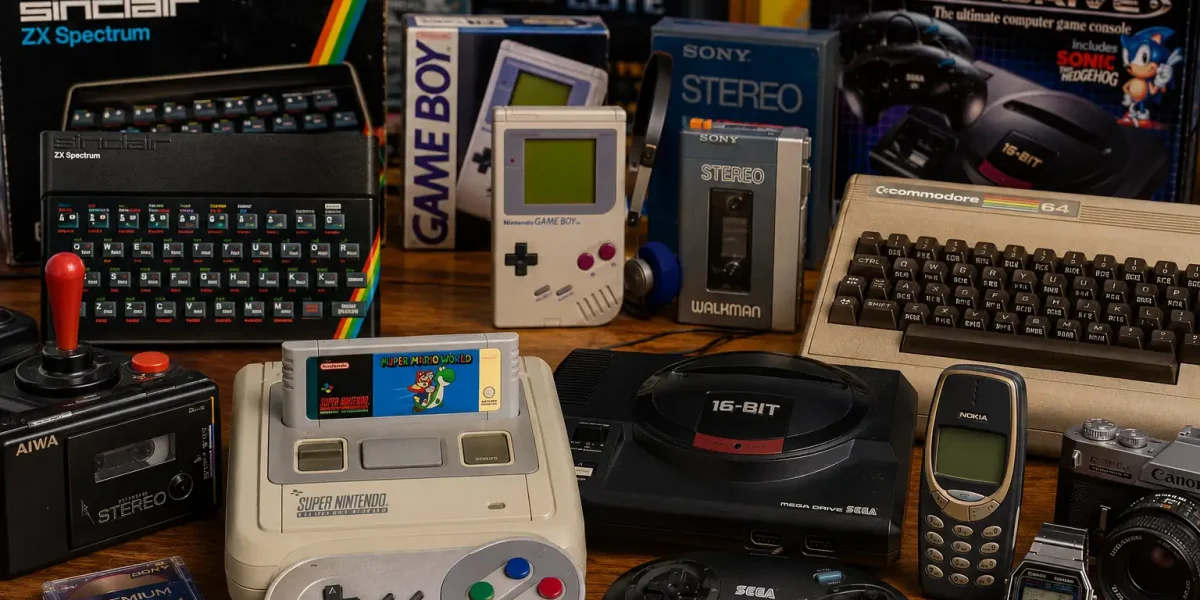
There was a time when loading a computer game meant waiting for a cassette tape, taking music outside required a pocket full of AA batteries, and getting a new games console at Christmas could occupy you for the rest of the school holidays.
Today, much of that technology is obsolete in practical terms. As collectables, however, it is a very different story.
Retro technology has become one of the most interesting areas of modern collecting in the UK. Early home computers, handheld games consoles, portable cassette players, calculators, personal organisers and even certain mobile phones have moved from drawers and lofts into display cabinets and specialist collections.
Some pieces are collected because they represent genuine milestones in technology. Others are wanted because millions of people remember owning them. And, as with most collectables, the examples that survived complete, original and in excellent condition can be very different from the battered examples that spent twenty years in somebody’s garage.
So, which pieces of retro tech are particularly worth looking out for in the UK?
What Counts as Retro Tech?
There is no official age at which technology becomes “retro”. In collecting circles, the term generally covers technology that has been superseded but retains historical, cultural, design or nostalgic interest.
For UK collectors, that can include:
- 1980s and 1990s home computers
- Early games consoles and handheld systems
- Cassette, CD and MiniDisc players
- Vintage mobile phones and pagers
- Early digital cameras and camcorders
- Electronic organisers and PDAs
- Calculators and electronic games
- Computer peripherals, joysticks and accessories
- Boxed software and video games
- Early Apple, Acorn, Sinclair, Commodore, Nintendo, Sega and Sony products
Importantly, old does not automatically mean valuable. Plenty of technology was manufactured in enormous quantities and remains easy to find. Collector demand tends to concentrate around significant models, unusual variations, limited editions and exceptionally complete examples.
1. Sinclair ZX Spectrum
Few computers are as closely associated with the British home-computing boom as the Sinclair ZX Spectrum.
Released in 1982, the Spectrum brought affordable colour computing into British homes and became a defining machine for a generation of programmers and gamers. The Science Museum Group records the ZX Spectrum as one of Sinclair Research’s most important commercial successes, noting that it helped the company achieve market dominance in the UK during the early 1980s.
Its distinctive rubber keyboard, rainbow stripe and tiny dimensions make an original Spectrum instantly recognisable.
The early machines are particularly interesting, but collectors should also watch for later Spectrum+, ZX Spectrum 128 and other variations.
What to look for
- Original 16K and 48K machines
- Early serial numbers
- Original Sinclair packaging
- Power supplies and RF leads
- Instruction manuals and Horizons software packs
- Boxed games and software
- ZX Spectrum 128 models
- Unusual accessories and peripherals
Condition matters enormously. An unboxed Spectrum with missing keys and an uncertain power supply is a very different proposition from a clean, boxed machine with its original paperwork.
Collectors should also be cautious about automatically powering up computers that have been stored for decades. Ageing power supplies and electrical components can fail.
2. BBC Micro
The BBC Micro occupies a slightly different place in British computing history. For many people, it was the computer they first encountered at school.
The machine emerged from the BBC’s Computer Literacy Project and was manufactured by Acorn. According to the Computer History Museum, the project was intended to introduce adults to computing, with the BBC Micro allowing viewers to follow the BBC’s computer programming broadcasts at home.
Its presence in British schools gave the BBC Micro enormous cultural importance. Many programmers, developers and technology entrepreneurs had their first meaningful experience of computing on an Acorn machine.
Collectors tend to look for BBC Micro Model A and Model B machines, together with monitors, disk drives, manuals and original software.
Don’t ignore the accessories
A plain computer may be interesting, but a complete period setup can be considerably more appealing. Original Acorn monitors, disk drives, joysticks, manuals, educational software and boxed peripherals can all have their own collector following.
3. Original Sony Walkman Models
The Sony Walkman did something that seems completely ordinary today. It allowed people to carry their music with them.
When the original Sony TPS-L2 appeared in 1979, personal portable stereo listening was still a novel concept. Sony describes the TPS-L2 as the first Walkman, a machine that helped create an entirely new way of listening to music.
There is also a particularly interesting British connection. Sony records that the original machine was initially marketed as the “Stowaway” in the United Kingdom before Walkman became the standard international name.
Early Sony portable cassette players are consequently some of the most recognisable pieces of vintage consumer electronics.
Most interesting Walkman finds
Collectors should look beyond simply finding something with “Walkman” written on it. Sony produced a huge number of models.
Particularly interesting pieces can include early TPS-series machines, unusual colourways, Sports models, premium metal-bodied machines and examples with their original headphones, cases, boxes and paperwork.
The same principle extends into later formats. Sony’s portable technology eventually included Discman/CD Walkman and MiniDisc Walkman products. Sony launched its D-50 portable CD player in 1984 and its first MiniDisc Walkman models followed in 1992.
4. Nintendo Game & Watch
Before Game Boy, Nintendo had Game & Watch.
These compact LCD games arrived during the 1980s and are now highly recognisable collectables. Nintendo itself describes Game & Watch as its first handheld gaming system and a foundation for later machines such as the Game Boy and Nintendo DS.
The attraction today comes partly from their importance to Nintendo’s history and partly from the number of different games and designs produced.
For collectors, original packaging can make a substantial difference. Battery covers are another seemingly minor detail worth checking because they are frequently missing from well-used examples.
5. Original Nintendo Game Boy
If Game & Watch established Nintendo’s handheld credentials, the Game Boy turned portable gaming into a global phenomenon.
Launched in Japan in 1989 and Europe in 1990, the Game Boy combined interchangeable cartridges with impressive battery life and a library that would eventually include titles such as Tetris, Super Mario and Pokémon. Nintendo states that the Game Boy family went on to sell more than 100 million units.
That huge production figure means a standard loose Game Boy is not automatically rare. What makes collecting interesting is the enormous range of variations around it.
Look out for original DMG-01 systems in exceptional condition, Play It Loud! colours, Game Boy Pocket models, promotional editions and complete boxed examples.
Games matter too. Original cartridges with their boxes, inserts and manuals are far less common than loose cartridges because cardboard packaging was so frequently discarded.
6. Sega Mega Drive and Nintendo SNES
For anyone who grew up in Britain during the early 1990s, the Nintendo versus Sega rivalry needs little introduction.
The Sega Mega Drive and Super Nintendo Entertainment System represent one of the most nostalgic periods in console collecting. Sonic the Hedgehog, Super Mario World, Street Fighter II, The Legend of Zelda and countless other titles helped turn the machines into household names.
Nintendo’s own company history records the European SNES launch in June 1992 and worldwide sales of more than 46 million units.
Once again, rarity and completeness are more important than age alone. Standard consoles are relatively obtainable, while unusual bundles, promotional editions and genuinely complete boxed examples can be much harder to find.
Collectors should pay close attention to original UK and European packaging. Imported Japanese and North American machines can also be collectable, but they represent different markets and should be identified accurately.
7. Commodore 64 and Amiga Computers
Sinclair and Acorn were not alone in British bedrooms. Commodore built an enormous following in the UK.
The Commodore 64 became one of the defining home computers of the 1980s, while the Amiga family became enormously popular for gaming, graphics and multimedia during the late 1980s and 1990s.
Amiga 500 machines are still regularly encountered, but interesting versions, original monitors, Commodore-branded peripherals and complete boxed systems are increasingly appealing to collectors.
Software is another field in itself. Big-box Amiga games with manuals, maps, posters and other original inserts can be much harder to find complete than the computers themselves.
8. Early Apple Computers and Macintosh Models
Vintage Apple collecting can move into an entirely different price bracket.
Early Apple hardware attracts collectors interested in both computing history and industrial design. While truly early Apple computers are uncommon finds in Britain, later Macintosh machines, PowerBooks, colourful iMacs and early iPods are much more realistic discoveries.
One important lesson with Apple collectables is not to assume that every old Macintosh is valuable. Some are bulky, difficult to store and relatively plentiful.
Desirable characteristics can include:
- Historically important models
- Unusual specifications
- Original keyboards and mice
- Original packaging
- Installation media and manuals
- Rare colour or configuration options
- Excellent cosmetic condition
Early iPods are also increasingly relevant to retro-tech collecting as the devices that once represented cutting-edge digital music now qualify as genuine pieces of early-2000s technology history.
9. Vintage Mobile Phones
Old mobile phones were once the sort of thing people threw into a kitchen drawer and forgot about. That is precisely why some are now interesting.
Nokia, Motorola, Ericsson and other manufacturers produced an extraordinary variety of handsets during the 1980s, 1990s and early 2000s.
Collector interest is strongest around recognisable or historically important designs. Early “brick” mobiles, Motorola flip phones, Nokia Communicators, distinctive Nokia handsets and early smartphones can all attract attention.
Original boxes, chargers, docks, manuals and accessories can transform what appears to be an ordinary old phone into a much more interesting time capsule.
Be particularly careful with ageing rechargeable batteries. Swollen, leaking or damaged lithium batteries should not be charged or casually stored with a collection.
10. MiniDisc Players
MiniDisc occupies a fascinating point between the cassette and MP3 eras.
Introduced by Sony in 1992, MiniDisc offered a small, recordable digital format at a time when CDs dominated recorded music. It never completely replaced the formats around it, but it developed a loyal following.
That makes MiniDisc equipment particularly attractive to collectors who remember the technology from the 1990s and early 2000s.
Portable Sony MiniDisc recorders, premium models, unusual colours, boxed machines and home decks are all worth watching for. Blank and pre-recorded MiniDiscs have also developed their own collector market.
11. Early Digital Cameras
This is a newer collecting category and one worth watching.
For years, early digital cameras seemed undesirable because newer cameras were objectively better. Now the limitations are becoming part of their appeal.
Chunky bodies, tiny LCD screens, strange memory cards and low-resolution sensors capture the look and feel of early digital photography in a way a modern smartphone deliberately cannot.
Models from Sony, Canon, Nikon, Olympus, Fujifilm, Kodak and Casio can all be interesting, particularly unusual early consumer models and cameras that introduced important technologies.
As with computers, don’t assume age equals value. Research the exact model number.
12. Calculators, Organisers and Forgotten Pocket Technology
Not every collectable needs to be a famous computer or console.
Some of the most enjoyable retro-tech finds are the smaller gadgets that technological progress completely replaced.
Electronic dictionaries, Casio databanks, Psion organisers, Palm PDAs, electronic translators, pagers and early digital assistants provide snapshots of how people worked before smartphones absorbed almost every function.
British collectors should pay particular attention to Psion. The company’s organisers and palmtop computers were a familiar sight among business users and technology enthusiasts in Britain, making complete examples particularly evocative pieces of UK computing history.
What Actually Makes Retro Tech Valuable?
Finding an old computer does not necessarily mean you’ve discovered a valuable collectable. Several factors usually determine desirability.
Rarity
How many were made and, more importantly, how many survive? A product may once have been common but become difficult to find because most examples were discarded.
Condition
Cracked plastics, missing battery covers, screen damage, corrosion, yellowing and broken buttons can substantially affect desirability.
However, don’t immediately start restoring an item. Aggressive cleaning, retrobrighting plastics or replacing original components may be undesirable to collectors who value originality.
Original packaging
The box can sometimes be almost as important as the technology inside it.
Packaging was designed to be discarded, meaning genuinely complete examples become progressively harder to find. Polystyrene inserts, plastic bags, warranty cards, manuals, catalogues and promotional leaflets all contribute to completeness.
Accessories
An original charger, controller, headphone set or carrying case can matter. Research exactly what was supplied with the product when new.
Working condition
Working equipment will generally be easier to sell, but there are exceptions. Collectors may deliberately buy non-working machines for restoration, spare parts or display.
If you have not tested something, say so. “Untested” is considerably more accurate than assuming an item works because it did the last time it was used in 1997.
Provenance
Most everyday electronics do not require extensive provenance, but documented ownership can become important for prototypes, demonstration equipment, development hardware, promotional pieces or technology associated with a notable person or company.
Where to Find Retro Technology in the UK
Some of the best discoveries still happen away from specialist dealers.
Collectors regularly search:
- Car boot sales
- House clearances
- Charity shops
- Local auctions
- Antiques centres
- Facebook Marketplace
- eBay
- Retro gaming events
- Computer fairs
- Specialist vintage technology dealers
Lofts and garages remain surprisingly productive too. Many families kept old technology because it seemed too expensive to throw away, even after it stopped being useful.
How to Research a Retro-Tech Find
Start with the exact manufacturer and model number rather than searching for a generic description such as “old Sony cassette player”.
Then check:
- The exact model and variation. Small revisions can make a substantial difference.
- The serial number. This may help establish manufacturing period or production version.
- Original specifications. Compare the item with museum archives, manufacturer records and period catalogues.
- Completeness. Find out what accessories were originally included.
- Recent sold prices. Asking prices tell you what sellers hope to receive. Completed sales provide a better indication of what buyers have actually paid.
- Condition. Compare like with like. A boxed example should not be valued using the sale price of a loose, damaged machine.
For historically significant British technology, museum collections can be invaluable. The Science Museum Group Collection contains detailed records of computers, telecommunications equipment and consumer technology, while the Computer History Museum provides useful international context.
Be Careful Before Plugging Vintage Technology In
There is an important difference between collecting an old electronic device and safely using one.
Decades-old power supplies, capacitors, plugs, cables and batteries can deteriorate even when the equipment looks perfectly acceptable externally.
The UK Office for Product Safety and Standards advises buyers of second-hand products to check their condition, confirm that products have not been dangerously modified and check whether an item is subject to a product recall. Its second-hand product safety guidance specifically notes that used electrical and mechanical devices can present increased risks because of worn components, modifications or missing modern safety features.
If you are unsure about the electrical condition of a vintage device, don’t simply plug it in to see what happens. Have it inspected by somebody competent to assess or repair vintage electrical equipment.
This is particularly important when original mains adapters and power supplies are involved. A modern replacement should also be checked carefully for the correct voltage, polarity and current requirements rather than chosen because the connector happens to fit.
You can also search the UK Government’s Product Safety Alerts, Reports and Recalls database when checking second-hand electrical equipment.
Selling Retro Electrical Equipment in the UK
Anyone turning retro-tech collecting into a regular business should understand that selling old electrical equipment involves more than finding stock and listing it online.
Businesses supplying second-hand goods have responsibilities regarding product safety. UK Government guidance makes clear that commercially sold used products must be safe, even though older products may not contain the safety features expected from modern equivalents.
The precise requirements depend on the item, its age, how it is being supplied and whether it has been modified or substantially refurbished. Businesses dealing regularly in vintage electronics should therefore familiarise themselves with current UK product safety guidance and obtain specialist advice where necessary.
If an electrical item is no longer suitable for reuse and is being discarded rather than resold, waste electrical and electronic equipment rules may also become relevant. Current guidance is available from GOV.UK on used electrical and electronic equipment and WEEE.
Should You Restore Retro Tech?
This depends entirely on the object.
For a machine intended for regular use, sympathetic restoration may be sensible. Replacing failed capacitors, repairing drives or carefully cleaning internal components can keep historically interesting technology operating.
From a collector’s perspective, however, originality has value.
Replacing a badly damaged component is one thing. Repainting a case, replacing labels, modifying hardware or aggressively whitening aged plastics is another.
Before restoring something potentially rare:
- Identify the exact model first
- Photograph its original condition
- Research whether the parts are original
- Avoid irreversible cosmetic changes
- Keep any original components that are removed
- Use a specialist for valuable or historically important equipment
A slightly yellowed but completely original computer may be more appealing to some collectors than a gleaming example that has been extensively rebuilt.
Retro Tech That Could Become More Collectable
One of the interesting things about this market is that the definition of “retro” keeps moving.
Today’s forgotten drawer clutter can become tomorrow’s nostalgia.
Technology from the late 1990s and 2000s is already moving into this territory. Early iPods, MiniDisc equipment, first-generation smartphones, unusual MP3 players, digital cameras, Nintendo handhelds and distinctive mobile phones are increasingly being viewed as collectables rather than merely obsolete electronics.
That doesn’t mean buying every old gadget you encounter. A better approach is to look for products that were culturally important, visually distinctive, technologically significant or produced in unusual versions.
Complete packaging is worth keeping too. If today’s collectors have taught us anything, it is that throwing the box away is usually the bit everyone regrets twenty years later.
Frequently Asked Questions About Collecting Retro Tech
What retro technology is most collectable in the UK?
Classic British computers such as the Sinclair ZX Spectrum and BBC Micro have strong historical significance, while Nintendo, Sega, Commodore, Sony and Apple products have broad international collector followings. Exact model, rarity, condition and completeness are more important than brand alone.
Are old computers worth money?
Some are, but many common machines have relatively modest values. Rare models, early versions, unusual configurations and complete boxed systems tend to attract greater collector interest. Always research the exact model rather than relying on the age of the computer.
Are old Game Boys collectable?
Yes. Standard Game Boys remain relatively obtainable because enormous numbers were sold, but excellent boxed examples, unusual colours, limited editions and complete games can be much more desirable.
Is a Sony Walkman worth collecting?
Certain models are highly collectable, particularly early machines and unusual or premium versions. The original TPS-L2 is historically significant as the first Walkman, while later Sports, professional and premium models have their own followings.
Does original packaging increase the value?
Often, yes. Boxes, manuals, inserts, warranty cards and original accessories can significantly improve the desirability of vintage technology, particularly when they are in good condition.
Should I test an old computer before selling it?
Only if it can be done safely. Old power supplies and electrical components can fail after decades in storage. If you are uncertain about its condition, describing the equipment accurately as untested may be preferable to risking damage to the machine or yourself.
Where can I check the history of vintage computers?
Museum collections, manufacturer archives, period magazines and specialist computing museums are good starting points. For British technology, the Science Museum Group Collection is particularly useful for researching historically significant equipment.
Final Thoughts
Retro technology is appealing because these objects represent more than obsolete electronics. They document how quickly everyday life has changed.
The ZX Spectrum recalls the moment thousands of British children discovered programming. The BBC Micro takes us back to school computer rooms. The Walkman changed where we listened to music. The Game Boy turned a long car journey into an opportunity to play Tetris. Early mobile phones remind us that simply making a telephone call away from home once felt futuristic.
For collectors, the most wanted items tend to combine that nostalgia with rarity, originality, condition and historical importance.
So before clearing out an old drawer, loft or box of “outdated” electronics, check what is actually there. Find the model number, look for the original accessories and, most importantly, don’t throw the box away.
Yesterday’s technology has a habit of becoming tomorrow’s collectable.


Leave a Reply