The retro tech UK market is booming, but it is also riddled with pitfalls that can cost collectors money and frustration – from paying over the odds for non-working hardware to unknowingly destroying value with well-intentioned repairs.
Quick Summary
- The UK retro tech market covers everything from 8-bit home computers to vintage Hi-Fi and early mobile phones
- Over-restoring or modifying equipment without disclosure is one of the most common and costly mistakes
- Misidentifying common models as rare variants leads to systematic overpayment
- Ignoring condition grades and missing components dramatically affects real-world value
- Selling on the wrong platform means leaving significant money on the table
The UK Retro Tech Market: An Overview
Retro technology collecting has undergone a remarkable transformation in the UK over the past decade. What was once a niche pursued by engineers and nostalgic enthusiasts has become a genuinely competitive collector market, with pieces that sold for a few pounds at car boots in the 2000s now commanding hundreds or even thousands of pounds through specialist channels.
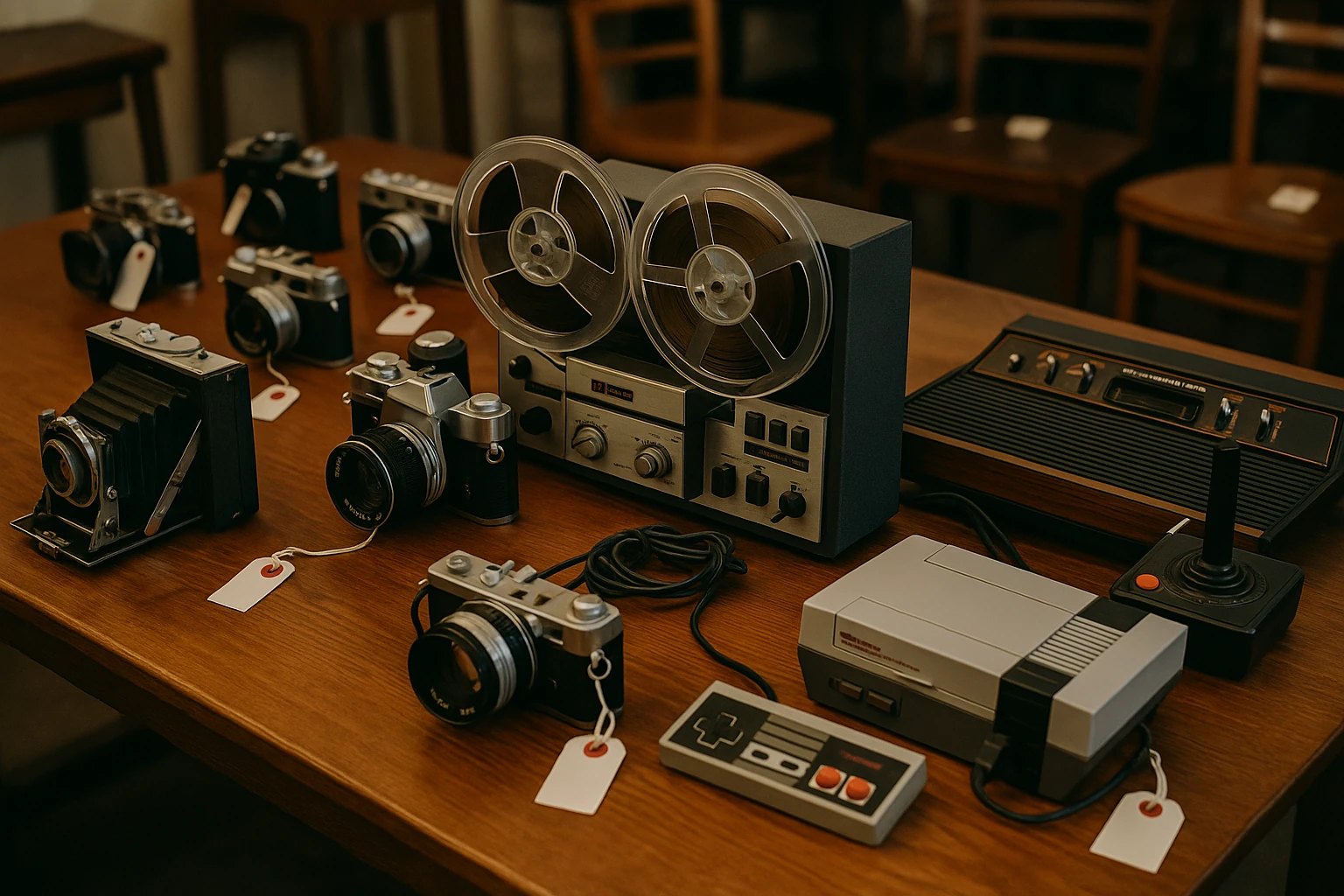
The market encompasses an extraordinarily broad range of items: home computers of the 1970s and 1980s, vintage Hi-Fi separates and reel-to-reel tape machines, analogue cameras from the rangefinder era through to early autofocus SLRs, early personal computers, portable gaming devices, vintage synthesisers, and even early mobile phones from the 1990s. Each of these sub-categories has its own collector community, its own price logic, and its own set of pitfalls.
UK demand is particularly strong in a number of areas. The Sinclair ZX Spectrum and BBC Micro, both British-designed home computers from the early 1980s, occupy a place of genuine cultural nostalgia that sustains collector premiums well above comparable foreign machines. Vintage British audio equipment – Quad amplifiers, Leak valve amplifiers, Garrard turntables – is internationally sought after, with buyers in the United States, Japan, and continental Europe competing against domestic collectors.
According to data from completed eBay UK sales and specialist auction results, the retro tech market has grown significantly since 2018, with prices for key categories such as early Apple computers, Sinclair hardware, and high-end vintage audio appreciating at rates that have outpaced mainstream antiques in the same period. This growth has attracted new buyers – many of whom are enthusiastic but under-informed – and with them, a new wave of mistakes that cost collectors money.
What Counts as Retro Tech?
Before exploring the mistakes collectors make, it is worth establishing what the retro tech category actually covers in the UK market context. There is no universally agreed definition, but the practical collector market tends to apply a loose framework: consumer electronics and computing devices produced between approximately 1950 and 2005 that are no longer in mainstream production and have acquired a demonstrable collector following.
Key categories within UK retro tech collecting include:
- Home Computers (1977–1995): Sinclair ZX81, ZX Spectrum and variants, BBC Micro, Acorn Electron, Commodore 64, Amstrad CPC range, Amiga series, Atari ST range.
- Vintage Audio: Reel-to-reel tape machines (Ferrograph, Revox, Tandberg), valve amplifiers (Leak, Quad, Rogers), vintage turntables (Garrard, Thorens, Linn Sondek), vintage Hi-Fi separates from the 1960s–1980s.
- Analogue Cameras: 35mm SLRs and rangefinders (Leica, Nikon F-series, Canon AE-1), medium format cameras (Hasselblad, Rolleiflex), vintage Kodak and Agfa models.
- Gaming Hardware: Atari 2600 and variants, original Nintendo Game Boy, SEGA Mega Drive, early PlayStation consoles, arcade cabinets and PCBs.
- Early Mobile Technology: Brick phones (Motorola DynaTAC, Nokia 3310), early PDAs, first-generation smartphones.
- Vintage Synthesisers: Roland, Moog, Korg, and Yamaha analogue and early digital synthesisers from the 1970s and 1980s.
The breadth of this category is itself a source of mistakes: collectors who are expert in one area – say, 8-bit home computers – may make elementary errors when straying into vintage audio or analogue cameras, where the condition standards, valuation logic, and technical knowledge requirements are quite different.
Valuation Mistakes
Misvaluation is the foundational mistake from which most other errors flow. Paying too much, selling too cheaply, or setting an unrealistic reserve – all stem from inadequate research into what the market actually pays for a specific item in a specific condition.
Confusing Asking Price with Market Value
The single most common valuation mistake is consulting current listings rather than completed sales. On eBay, any seller can ask any price for any item – and many sellers, particularly casual or uninformed ones, price at wildly optimistic levels that never result in a sale. The only prices that matter are those that buyers have actually paid. Always filter eBay searches to show “Sold Items” only, and cross-reference with specialist auction results from houses such as Ewbank’s Auctions in Guildford, which holds dedicated vintage technology sales.
Misidentifying Variants and Editions
Within popular retro tech categories, variant identification is critical to accurate valuation. A Sinclair ZX Spectrum 48K is a common, widely available machine worth £30–80 depending on condition. A Sinclair ZX Spectrum Issue 1 with a specific keyboard type and early board revision, however, is considerably rarer and commands a significant premium among serious collectors. Similarly, a standard BBC Micro Model B is quite different in value from the rarer BBC Master 512 or BBC Master Turbo variants.
In vintage audio, the distinction between different production runs of the same amplifier can mean a price difference of several hundred pounds. A Quad II amplifier from the early 1950s is not the same – in value or in sound – as a later 1960s example. Collectors who treat all examples of a model as equivalent are consistently either overpaying or underselling.
Applying UK Prices to International Comparables
UK retro tech prices do not always mirror US or European prices for the same equipment. Some British-designed machines command significant premiums in the UK market that are not replicated abroad. Conversely, American-designed hardware – early Apple computers, certain Commodore models – often sells for more in the US than in the UK. Checking sold prices specifically on eBay UK (rather than the global eBay) and through UK auction results gives the most relevant benchmarks for UK sellers and buyers.
Common Buying Mistakes
Buying Untested Without Appropriate Discount
The phrase “sold as seen – untested” is ubiquitous in the retro tech market and carries a specific implication: the seller either knows or suspects the item does not work and is declining to confirm functionality. Buying untested equipment is entirely legitimate – many skilled collectors acquire non-working machines, repair them, and build significant value – but only if the price reflects the unknown condition and the cost of repair.
Too many buyers pay near-working prices for untested equipment, only to discover that repair requires specialist components, skilled labour, or simply is not economically viable. Before bidding on untested retro tech, research the common failure modes for that specific model, estimate realistic repair costs, and price your maximum bid accordingly. For complex repairs, such as re-capping a vintage amplifier or recapping a 1980s computer, professional estimates from a specialist technician are advisable before committing significant sums.
Ignoring the Importance of Original Packaging and Accessories
Original packaging – boxes, polystyrene, inner sleeves, instruction manuals, original cables, and accessories – can account for a very significant proportion of a retro tech item’s value, particularly for gaming hardware and home computers. A Sinclair ZX Spectrum in its original box with instructions and accessories is worth substantially more than the same machine without them. Yet buyers frequently focus only on the main unit and pay accordingly, then discover that sourcing period-correct accessories is difficult, expensive, and sometimes impossible.
When evaluating a purchase, establish at the outset what accessories and packaging are included and what is missing. Adjust your valuation and offer accordingly. Sellers who include all original components deserve a premium and typically receive one at specialist auction.
Over-Relying on Photographs Alone
Online buying of retro tech carries an inherent risk that photographs cannot fully mitigate. Cosmetically clean equipment can harbour severe internal damage: corroded battery compartments, damaged capacitors, dry-jointed solder points, or modified boards that are invisible in surface photography. Wherever possible, request additional photographs of internal components, ask explicit questions about functionality and any known issues, and for higher-value purchases, arrange in-person inspection or use a trusted third-party buyer in the seller’s location.
Restoration and Repair Mistakes
Restoration decisions represent some of the most consequential – and most frequently regretted – mistakes in the retro tech collector world. The challenge is that what constitutes “appropriate” restoration is genuinely contested, and different buyer segments have very different expectations.
Retrobrighting: The Irreversibility Problem
Many plastic-housed retro computers and gaming hardware from the 1980s and 1990s suffer from yellowing of the original plastic, caused by a photochemical reaction in the original ABS plastic compound. “Retrobrighting” – a process using hydrogen peroxide and UV light to reverse this yellowing – is widely practised in the retro tech community and can produce dramatically improved aesthetics.
However, retrobrighting is irreversible if done incorrectly, and even when done well, can lead to uneven colour, patchy results, and in some cases further degradation of the plastic over time. Critically, a growing segment of the collector market now specifically prefers original, unretrobrighted examples – patina and original condition are increasingly valued markers of authenticity. Retrobrighting a machine before selling it without disclosure can reduce its value to this buyer segment and expose the seller to disputes about condition misrepresentation.
The guidance from most experienced retro tech dealers and collectors is: do not retrobright before selling unless you are certain your buyer wants a cosmetically restored machine and you are prepared to disclose the treatment fully. If you are collecting for personal use, retrobright only what you intend to keep and use yourself.
Replacing Original Components Without Disclosure
Replacing capacitors (“recapping”), fitting modern replacement chips, or installing modern display adaptors in vintage computers are all legitimate and often necessary modifications. But they are modifications – and failing to disclose them to buyers is both unethical and potentially illegal under UK consumer protection law.
Some collectors specifically seek all-original, unmodified examples for museum-quality preservation purposes and will pay a premium for them. Others prefer modernised, fully functional machines and will value disclosed modifications positively. The mistake is in assuming that all buyers share your own preferences and in failing to provide full disclosure.
Cosmetic Over-Restoration of Vintage Audio
In the vintage Hi-Fi market, over-restoration carries specific and well-understood risks to value. Valve amplifiers and early transistor equipment that retains its original finish, original components, and period-correct appearance commands premiums from serious collectors. Polishing cases, replacing original knobs and dials with non-period reproductions, or applying modern finishes to wooden cabinets all reduce value with informed buyers, even when the aesthetic result seems superior.
In vintage audio, the principle that guided Sotheby’s and Christie’s specialists for decades applies with equal force: preserve, do not improve. Stabilise and clean; avoid cosmetic enhancement.
Common Selling Mistakes
Choosing the Wrong Platform for the Item’s Value
The UK retro tech market is served by multiple selling channels, each suited to different price points and buyer types. Using eBay to sell a common, low-value item makes sense – the platform’s reach maximises buyer competition for accessible pieces. But using eBay to sell a rare or high-value piece – a first-edition Apple I, a working Moog synthesiser, or a collection of BBC Micro prototype hardware – is almost certainly leaving money on the table, as the specialist buyer community for such items includes international collectors who use specialist platforms, dealer networks, and auction houses.
For significant pieces, consider a tiered approach: start with specialist dealers or collectors, then consider a specialist auction house sale, and use eBay only as a last resort or for clearly accessible, broadly appealing items.
Poor Photography and Listing Descriptions
Retro tech buyers are typically knowledgeable and need specific information to bid with confidence. A listing that shows only the front of a machine, provides no information about functionality, and describes the item simply as “old computer, untested” will underperform dramatically against a listing with multiple detailed photographs (front, back, internals, maker marks, all accessories), a clear statement of working condition, and full disclosure of any modifications.
Always photograph: the main unit from multiple angles; the back panel showing all ports; the power lead and any accessories; the board or internals if relevant to condition assessment; any labels, serial numbers, or identifying marks; and all packaging if present. Write descriptions that answer the questions an informed buyer will ask, not just the questions you thought to answer.
Selling Individual Items from Collections
Complete collections of related items – a full run of Spectrum software, a matching set of Hi-Fi separates, a collection of original manuals and magazines – are worth more as curated lots than as individual items. Splitting collections to achieve quick sales is a consistent source of undervaluation. If time permits, selling complete lots to specialist dealers or at specialist auction significantly outperforms piecemeal selling on general platforms.
Condition Grading Errors
The retro tech market does not have a universally standardised condition grading system equivalent to that used in coin or stamp collecting. This creates consistent confusion and dispute between buyers and sellers. Common condition errors include:
- Describing “working” without qualification: A machine that powers on but has a degraded keyboard, non-functioning tape interface, or minor screen issues is not in the same condition as a fully functional example. Specify precisely what works and what does not.
- Using “good condition” without reference to category standard: “Good condition” for a 40-year-old computer means something very different to different buyers. Describe actual condition – yellowing level, presence of scratches, missing keys, condition of leads – rather than using vague evaluative language.
- Ignoring cosmetic issues in valuations: Many sellers focus on functionality and ignore cosmetic condition when pricing. For collectables, both matter. A working but heavily yellowed and scratched Spectrum will sell for considerably less than a working example in excellent cosmetic condition, and pricing should reflect this.
The Missing Components Problem
In the retro tech market, what is missing from an item is often as important as what is present. Buyers – particularly those collecting complete examples – place significant value on the completeness of a set. Common missing component issues that affect value include:
- Power supplies: Original power supplies for vintage computers and audio equipment are frequently lost or replaced with non-original alternatives. A machine sold without its original PSU, or with an aftermarket replacement, should be priced accordingly – typically 20–40% below a complete example, depending on the difficulty of sourcing an original PSU.
- Instruction manuals and documentation: Original manuals, quick-start cards, warranty cards, and registration documents are highly valued by collectors and significantly affect the price of home computers and gaming hardware in particular.
- Game cartridges and software: For gaming hardware, original software in its original box with instructions is a significant value component. Machines sold as complete with all games often command premiums of 50–100% over the hardware alone.
Storage and Preservation Mistakes
Long-term storage errors cause significant, often irreversible damage to retro tech that reduces value and in some cases makes items unsaleable. Key mistakes include:
- Storing with batteries installed: This is among the most damaging mistakes in retro tech preservation. Batteries in vintage electronic equipment – particularly alkaline cells in gaming hardware, remote controls, and portable devices – corrode when left in place, and the resulting chemical leakage can destroy internal components. Always remove batteries before long-term storage.
- Damp and condensation exposure: Analogue electronics are highly sensitive to moisture. Storage in garages, lofts, and outbuildings subject to temperature fluctuations causes condensation damage that manifests as corrosion on circuit boards and contacts. Climate-controlled indoor storage is strongly preferable.
- Direct sunlight exposure: UV light accelerates the yellowing of ABS plastics used in 1980s and 1990s consumer electronics. Even a few months of regular sunlight exposure can permanently alter the colour of a machine. Store away from windows and direct light sources.
- Stacking heavy items on fragile equipment: Many vintage computers and audio components use fragile plastic casings that crack under sustained pressure. Store items individually or with appropriate padding, never stacked under heavier equipment.
Scams and Fraud in the Retro Tech Market
As prices in the retro tech market have risen, fraud has become a more significant risk. UK buyers and sellers should be aware of several specific threats:
- Reproduction parts passed as original: The market for reproduction parts for popular retro computers and gaming hardware is well-developed and legitimate – but these parts are occasionally sold by unscrupulous sellers as original components. High-value items such as original Spectrum 48K rubber keyboards, original BBC Micro manuals, and original Nintendo game cartridges are all subject to convincing reproductions. Use specialist knowledge or consult expert collectors before purchasing purportedly original components at premium prices.
- Non-paying buyers at auction: On eBay and other platforms, auction-format listings attract occasional non-paying bidders who inflate prices but do not complete purchases. Set a minimum price (reserve) on high-value lots and report non-paying bidders promptly to maintain platform integrity.
- Shipping damage fraud: Claims of damage in transit that in fact reflect pre-existing condition are a risk when selling high-value retro tech. Photograph every item comprehensively before packaging, retain packaging materials for photographic evidence, and use reputable couriers with appropriate insurance. For high-value items, require signature on delivery.
Legal Considerations
UK sellers of retro tech operating at commercial scale – regularly buying and selling for profit rather than as a private collector – are subject to UK consumer law obligations including the Consumer Rights Act 2015. Items must be as described, and sellers cannot disclaim responsibility for misrepresentation. Key legal points include:
- Undisclosed modifications or repairs that affect functionality or value constitute misrepresentation and may entitle buyers to a refund.
- Sellers operating as businesses (rather than occasional private sellers) must provide buyers with the right to return goods within 14 days under the Consumer Contracts Regulations 2013.
- Export of certain retro technology to some countries may require export licences, particularly for items with potential dual-use (civil and military) electronic components. This is a rare consideration for most collector transactions but should be noted for unusual or professional-grade equipment.
For guidance on selling obligations, the UK Government’s guidance on selling online provides a clear summary of seller obligations for individuals and businesses.
Useful UK Resources
- Ewbank’s Auctions – Guildford-based auction house with dedicated vintage technology sales and online results archive.
- The Centre for Computing History – Cambridge museum with outstanding collections of UK home computers and vintage tech, providing reference standards for collectors.
- Science Museum London – national collection of historic technology with strong online resource for identification and dating.
- British Numismatic Trade Association – useful model for understanding how specialist trade associations support responsible buying and selling in collector markets.
- UK Government: Selling Online – official guidance on legal obligations for online sellers.
FAQs
- What counts as retro tech in the UK collector market?
- In the UK collector market, retro tech typically refers to consumer electronics and computing devices produced between the 1950s and early 2000s. This includes home computers such as the Sinclair ZX Spectrum and BBC Micro, vintage audio equipment such as reel-to-reel tape machines and early Hi-Fi separates, analogue cameras, early mobile phones, arcade game machines, and portable gaming devices such as the original Game Boy.
- Should I clean retro tech before selling it?
- Light surface cleaning – removing dust and surface grime with appropriate materials – is generally beneficial. However, deep cleaning, repainting, re-capping capacitors unnecessarily, or replacing original components without disclosure can significantly reduce value. Always disclose any work carried out, and avoid irreversible modifications unless you are certain of the technical benefit and buyer expectation.
- Where is the best place to sell retro tech in the UK?
- The best venue depends on the item’s value and rarity. eBay UK remains the largest platform and reaches the widest buyer pool. For rarer or higher-value pieces, specialist dealers, Catawiki, or dedicated collector auction sales at houses such as Ewbank’s will achieve better results. Facebook groups dedicated to specific retro tech categories are increasingly popular for direct sales with lower fees.
- How do I know if my retro tech is genuinely rare or just old?
- Age alone does not confer rarity or value. The key questions are: was the item produced in limited quantities? Is it a significant model within its category? Is there collector demand specifically for this model? Research completed eBay sales, specialist collector forums, and auction house results to gauge genuine market interest before assuming rarity.
- What are the biggest risks when buying retro tech online?
- The main risks are: receiving untested items that are non-functional and not as described; buying items with undisclosed modifications or replaced parts; purchasing incomplete items; and buying reproduction or fake accessories. Always request detailed photographs and ask explicitly whether the item has been tested and whether any repairs or modifications have been made.
Glossary
- Retrobrighting – a chemical process using hydrogen peroxide and UV exposure to reverse the yellowing of ABS plastics in vintage electronics. Irreversible if done incorrectly.
- Recapping – the replacement of electrolytic capacitors in vintage electronic equipment. A common but consequential modification that should always be disclosed.
- All-original – describes a piece of retro tech that retains all its factory-fitted components without modification or replacement. Typically commands a premium from serious collectors.
- MIB (Mint in Box) – a collectable item in its original, unopened packaging, in as-new condition. The highest condition grade for packaged items.
- Sold as seen – a sale term indicating that the buyer accepts the item in its current condition and the seller makes no guarantee of functionality or completeness. Does not override statutory consumer rights when sellers operate as businesses.
- PCB – Printed Circuit Board; the internal electronic motherboard of a computing or electronic device.