
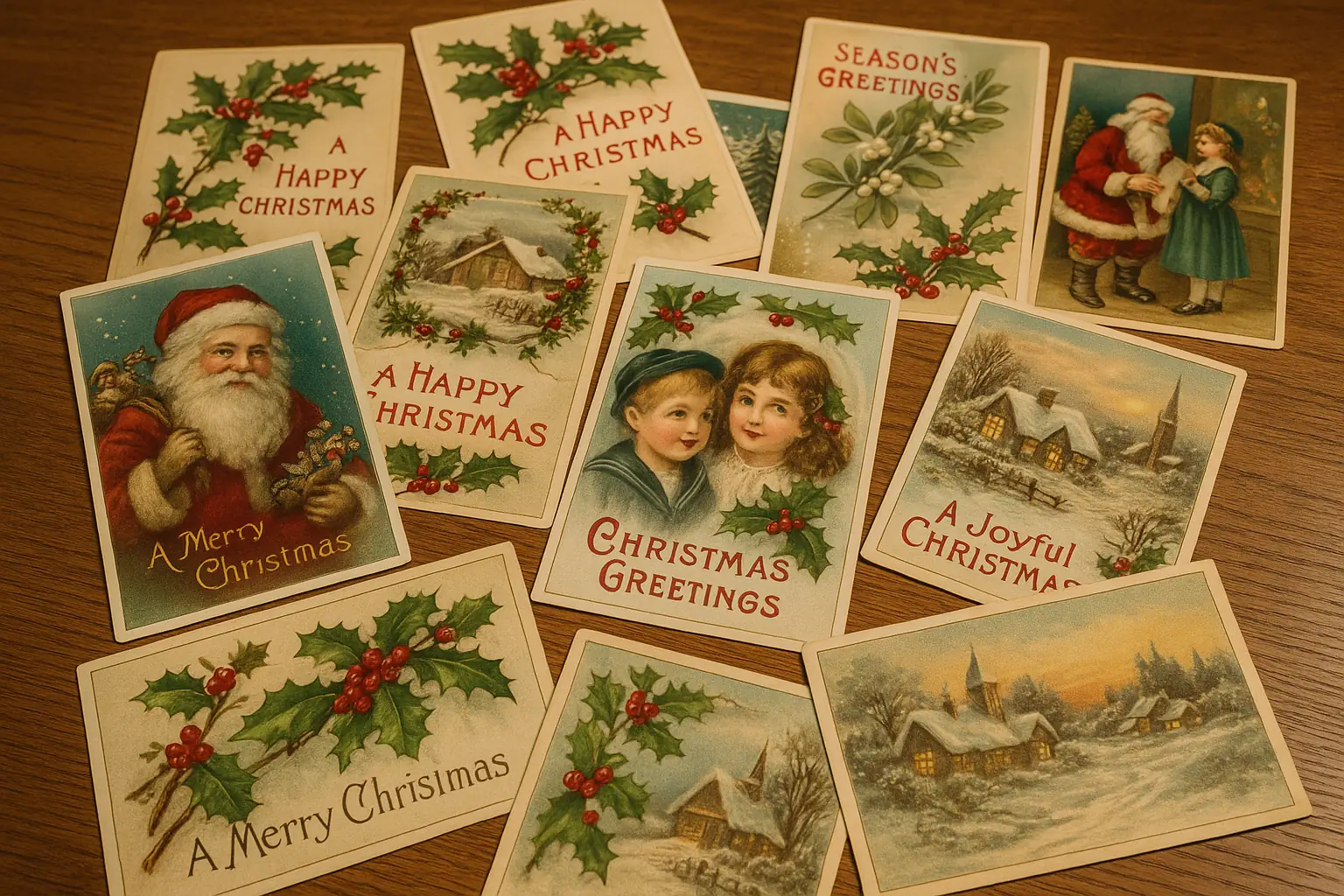
A Short History of Christmas Postcards (UK & Europe)
Britain helped invent the commercial Christmas greeting with Sir Henry Cole’s card in 1843, but it was the postcard format that made seasonal wishes truly mass-market. By the late 1890s, improved printing, cheap postal rates, and reliable delivery created the perfect conditions for illustrated Christmas postcards to flourish. The period 1898–1915 is often called the “Golden Age” of postcards: millions were sent each year across the UK and Europe.
Before the First World War, many of the finest cards were printed in Germany and Austria renowned for chromolithography. As Christmas approached, London streets, provincial arcades, and stationers filled with racks of snowy villlages, Father Christmas figures, angels, and holly-sprigged greetings. Postcards were affordable, quick to send, and collectible even then; people kept albums and swapped duplicates with friends.
War shaped the medium. In WWI, patriotic motifs mixed with festive scenes: soldiers receiving parcels, Red Cross imagery, flags woven into borders. Cards posted from training camps or fronts carry censor marks or military postmarks that add historical interest. In WWII, paper rationing encouraged simpler designs and shorter runs, but local printers and publishers kept the tradition alive.
By mid-century, postcards embraced the popular culture of their time cartoon Santas, tinsel and glitter, bold reds and greens. By the 1970s and 80s, photography often replaced illustration: snow-dusted cottages, carollers, and Christmas trees became the dominant look. While some collectors prefer the artistry of earlier eras, retro photographic cards now have a strong following of their own.
Collector’s Tip: The phrase “Printed in Germany” on a pre-WWI card is a hallmark of quality printing. Post-WWI, UK-made cards became more common, sometimes explicitly marked “British Manufacture.”
Publishers & Artists to Know
Publishers and artists can determine desirability and value. Learn the logos, back designs, and series conventions so you can identify noteworthy examples quickly.
Key UK/European Publishers
- Raphael Tuck & Sons (London) – The best-known British postcard publisher. Look for “Tuck’s Post Card” backs and lines such as Oilette (art-quality finish), Aquarette, and numbered series. Tuck hosted design competitions and commissioned leading illustrators; complete sets in fine condition can command serious premiums.
- Bamforth & Co. (Holmfirth/Yorkshire) – Famous for saucy comics later, but also produced charming seasonal cards. Many Bamforths were printed in Germany pre-WWI. Clean impressions and bright inks add value.
- Valentine & Sons (Dundee) – A major Scottish publisher; look for distinctive back designs and geographically themed series. Their winter scenes and photographic cards are well collected.
- Misch & Stock (London) and other British houses – Often distributed continental-printed cards for the UK market. Also watch for smaller provincial firms whose limited runs are now scarce.
- Continental Printers – Many British-market cards were printed in Germany, Austria, or Switzerland. “Printed in Saxony,” “Printed in Bavaria,” and similar notices frequently appear on high-quality Edwardian cards.
Artists & Signatures
Signed art elevates desirability. Some names you’ll see across British and American markets:
- Ellen H. Clapsaddle – An American illustrator associated with richly expressive children and Santa images. Highly sought after.
- Frances Brundage – Cherubic children, sentimental winter scenes; strong following among Christmas specialists.
- Mabel Lucie Attwell – Beloved British illustrator; her whimsical figures and hand-lettering remain popular.
- John Hassall – Notable Edwardian poster artist whose bold, graphic style appears on festive cards.
- Other signatures appear, sometimes obscure – research unfamiliar monograms; artist attribution can transform value.
Collector’s Tip: Keep a reference folder of publisher logos and artist monograms. When you spot an unusual signature on a market stall, you can confirm attribution on the spot.
Design Styles & Printing Methods
Knowing materials and techniques helps with both dating and valuation. Some formats are simply rarer or more fragile, so clean survivors are prized.
Printing & Finishes
- Chromolithography – Multi-stone colour lithography, especially fine on pre-WWI cards. Look for saturated colours and precise registration.
- Embossing – Raised designs, often on holly borders or snow; heavy embossing can crack at edges if mishandled.
- Hand Tinting – Colour applied by hand over printed outlines; subtle variances between copies are normal.
- Glitter & Flocking – Common from the 1930s–60s; “sugar” snow or fuzzy Santa robes. Very condition-sensitive loose glitter sheds easily.
- RPPC (Real Photo Postcards) – Actual photographic prints on postcard stock. Look for photographic paper brands or “Real Photograph” on the back. Regional snow scenes, parish choirs, and shopfronts at Christmas can be uniquely desirable.
Novelty & Mechanical
- Hold-to-Light – Cut-outs reveal illuminated windows or stars when held to a lamp. Earlier and scarcer; defects near cut-outs lower value.
- Die-cuts & Shaped Cards – Santa silhouettes, bells, holly sprays. Fragile tips and tabs make high-grade examples hard to find.
- Fold-outs & Booklets – Multiple panels or miniature booklets with verses. Watch for split folds and missing ties.
Style by Era
- Victorian/Edwardian – Art Nouveau borders, gilding, angels, Father Christmas in robes (often blue, green, or brown), and scenic snow villages.
- 1920s–30s – Art Deco geometry, streamlined Santas, graphic snowflakes. Novelty and mechanical formats thrive.
- 1940s – Rationed materials; plainer colour schemes; patriotic and religious emphasis; field-post provenance.
- 1950s–60s – Mid-century brightness, cartoon characters, flocked textures, and glitter. Charming kitsch now in demand.
- 1970s–80s – Photography dominates; cottage scenes, carollers, Christmas trees; regional/real-photo interest re-emerges.
Collector’s Tip: Condition aside, novelty cards (hold-to-light, mechanical, shaped) nearly always outperform standard flats when all else is equal.
Themes & Subjects That Sell
Specialising by theme helps you build a coherent collection and spot value quickly. These subjects are consistently popular:
- Santa/Father Christmas – Robed Victorian Father Christmas (sometimes blue or green) is highly collectible; early red-suited Santas with sleighs or reindeer also perform strongly.
- Snow & Winter Sports – Skaters, sledging, horse-drawn sleighs; Alpine and Scottish scenes have loyal followings.
- Children & Toys – Edwardian charm through to mid-century cuteness; dolls, trains, and teddy bears evoke strong nostalgia.
- Animals & Anthropomorphism – Cats, dogs, robins, farm animals (often in clothing) on festive errands.
- Religious & Nativity – Angels, madonnas, church services; fine art reproductions in the Oilette line are sought after.
- Patriotic & Wartime – WWI flags, soldiers writing home, Red Cross motifs; provenance-heavy cards can command premiums.
- Transport – Steam trains in the snow, early cars delivering gifts, London buses dressed for the season.
- Local & Regional – Real-photo postcards of town centres, shop windows, or civic Christmas trees, especially when postmarked from the same location.
Collector’s Tip: Cross-collectability drives value. A Christmas postcard featuring a steam train appeals to postcard collectors, railway enthusiasts, and Christmas specialists.
Dating & Authentication (Backs, Rates, Marks)
Dating is a skill you’ll refine over time. These signals will help you place a card within a decade or even a few years.
- Undivided vs Divided Back (UK): Britain authorised divided backs (message + address) in 1902. Cards with undivided backs typically pre-date this and are earlier.
- Postage Rates & Stamps: A halfpenny stamp for inland postcards was common in the Edwardian era. Later rates and commemoratives help narrow dates. Study the cancellation and any slogan postmarks.
- Publisher & Series: Tuck’s series names and numbers (e.g., Oilette) are well documented. Publisher imprints like “Printed in Germany” suggest pre-WWI; “British Manufacture” leans later.
- Typography & Language: Fonts, phrasing, and greetings (“Xmas” vs “Christmas”) shift by era.
- Printing & Paper: Early chromolitho is rich and layered; later offset litho and photographic stocks feel different. RPPC backs often show photographic paper brands.
Spotting Reprints: Modern reprints can be glossy with halftone dots visible under magnification; backs may have barcodes, modern addresses (with postcodes), or contemporary copyright. Genuine vintage cards typically show minor handling wear, ageing tones, and period-appropriate paper texture.
Collector’s Tip: Always examine the back. The layout, imprint, series number, and paper tone together tell a story, often more reliably than the artwork alone.
Condition, Grading & Value Drivers
Condition can double or halve a price. A common grading shorthand used by postcard dealers:
- Mint (M) – Unused, no wear, sharp corners, bright inks.
- Near Mint (NM) – Very minor corner rubs or toning.
- Excellent (EX) – Light wear, tiny crease or slight corner rounding; very presentable.
- Very Good (VG) – Noticeable corner wear or light creasing; colours good.
- Good (G) – Creases, edge nicks, or surface scuffs; still collectible if scarce or desirable subject.
- Fair/Poor – Heavy wear; suitable as fillers or for rare themes only.
Specific issues to check: tears at corners (especially on embossed/novelty), album mount marks, foxing (brown spots), water staining, fading from sunlight, “silvering” on photo cards, trimmed edges, and glue residue. Postally used cards are not automatically lower value interesting messages, rare postmarks, or matching local scenes can add appeal.
Value Drivers (quick view): scarce publishers/series, signed artists, novelty formats, RPPC of specific towns/railways, cross-collectable subjects (trains, animals), early divided/undivided backs, wartime provenance, complete sets in exceptional condition.
Collector’s Tip: If you can only check one thing in a hurry, check corners and edges damage there is both common and value-sensitive.
Where to Buy (UK Fairs, Dealers, Auctions, Online)
The UK remains one of the best places to find vintage Christmas postcards in quantity. Diversify your sources:
Fairs & Markets
- York National Postcard Fair – The UK’s flagship postcard event with specialist dealers and extensive Christmas stock each autumn.
- Shepton Mallet Antiques Fair & Newark International Antiques & Collectors Fair – Large general fairs with postcard dealers and ephemera stands.
- NEC Birmingham – Seasonal antiques fairs often feature postcard boxes arrive early for the best lots.
Dealers & Societies
- Postcard Traders Association (PTA) – Directory of vetted dealers; check fair calendars and member lists.
- Local postcard clubs – Ideal for learning, swaps, and buying in a friendly environment.
- Antique centres and antiquarian bookshops – Ask to see postcard stock not on display.
Auctions
- Specialist & regional auctioneers frequently include postcard collections and seasonal lots. Use The Saleroom to search catalogues and register for timed sales.
- Advantages: chance finds, large mixed lots, and provenance; watch buyer’s premiums and factor in postage for albums.
Online Marketplaces
- eBay UK – Huge daily supply; use “Sold Listings” for realistic pricing and save searches by theme/publisher.
- Delcampe – European-leaning marketplace with deep postcard inventory and good keyword filters.
- HipPostcard – Dedicated postcard platform; easy to browse by subject and era.
- Etsy – Mixed quality; useful for hunting novelty and mid-century kitsch but vet sellers for reprints.
Collector’s Tip: When buying online, request a close-up of corners, the back layout, and any embossing. For RPPC, ask for a raking-light photo to reveal surface condition.
Building a Collection: Strategies & Checklists
Collecting thrives on focus. Pick a path that fits your budget and interests, then build depth and quality over time.
Specialisation Ideas
- By publisher (e.g., Tuck lines and series numbers).
- By artist (Clapsaddle, Brundage, Attwell, Hassall).
- By format (embossed, hold-to-light, die-cut, RPPC).
- By theme (Santa variants, trains, animals, angels, snow sports).
- By region (postmarked from your county, town scenes at Christmas).
- By era (Victorian/Edwardian, interwar, wartime, mid-century).
Checklist Essentials
- Publisher imprint and series number/name.
- Back type (divided/undivided), country of origin, and any printer’s marks.
- Condition notes (corners, creases, embossing integrity, glitter loss).
- Postmark/stamp details and any notable message content.
- Provenance (album source, dealer/fair, auction lot number).
Budget & Upgrading
Start with mid-century illustrated cards (£2–£10) to learn grading and themes. As knowledge grows, target earlier chromolithos and novelty formats. Buy the best condition you can afford; upgrade when a nicer copy appears and sell or trade your duplicate.
Collector’s Tip: Keep a simple spreadsheet or database with thumbnail scans, purchase price, and notes. It will save time at insurance renewal and help you spot gaps in series.
Preservation, Storage & Display
Paper is vulnerable to light, humidity, acids, and handling. A few good habits will preserve your vintage Christmas postcards for decades.
Storage Materials
- Use archival, acid-free sleeves (polypropylene or polyester/Melinex) or paper envelopes buffered for acidity.
- Avoid PVC plastics these off-gas and cause irreversible damage.
- Store upright in acid-free boxes or in albums with archival interleaving sheets.
- Add silica gel sachets to boxes if you live in a humid environment.
Environment
- Keep at stable room temperatures (ideally 16–20°C) with moderate relative humidity (35–55%).
- Protect from direct sunlight; UV fades inks and degrades paper.
- Ventilate storage areas; avoid lofts/attics and damp cellars.
Handling & Cleaning
- Wash and dry hands before handling; light cotton or nitrile gloves are useful for glossy RPPCs.
- Do not attempt to clean with liquids or solvents. Surface dust can be lightly lifted with a soft brush.
- Never peel off old album corners or labels; seek a conservator’s advice for safe removal.
Digitisation & Display
- Scan at 600 dpi or photograph with diffuse lighting; capture the back as well as the front.
- Use UV-filtering glazing for framed displays; rotate displays to limit light exposure.
- Keep digital archives with filenames including publisher, series, and date for easy retrieval.
Collector’s Tip: If you inherit albums, keep them intact until you’ve documented layouts. Early owners arranged cards thematically provenance photos add value.
Ethics, Copyright & Reproductions
Antique postcards reflect the attitudes and advertising tropes of their time including some themes and depictions that are now offensive. Many collectors choose to contextualise rather than feature these items, or donate them to archives for research. When in doubt, handle sensitively and avoid public use without context.
Most pre-1940 images are safely out of copyright in the UK, but check for later publisher renewals or modern reprint rights. For selling reproductions (prints, calendars), consult the relevant rights guidance or seek permission from rights holders. Always label modern reprints clearly to avoid misleading buyers.
Selling & Shipping Safely
When the time comes to thin duplicates or fund upgrades, choose a sales route that fits your cards’ value and your time.
- Fairs & Clubs: Quick sales to dealers/collectors; lower fees; haggling expected.
- Online Marketplaces: Huge audience; list with clear photos (front/back), accurate grades, and precise themes (e.g., “Tuck Oilette Santa, embossed, blue robe”).
- Auctions: Best for larger collections/rare series; factor in seller’s commission and timelines.
Packing & Post: Use stiff card backers in a poly sleeve, then a rigid mailer. Mark “Do Not Bend.” For higher value items, use tracked and insured services. Avoid tape contacting sleeves.
Glossary (Deltiology Basics)
- Deltiology
- The study and collecting of postcards.
- RPPC
- Real Photo Postcard an actual photographic print on postcard stock.
- Chromolithography
- A multi-stone colour lithographic printing process common pre-WWI.
- Divided/Undivided Back
- Back layouts for address and message; the UK adopted divided backs in 1902.
- Hold-to-Light
- Novelty postcards with cut-outs that glow when held to a light source.
- Flocking
- Fuzzy, textured fibre applied to create soft surfaces (e.g., Santa’s suit).
- Embossing
- Raised relief created by pressing the paper stock.
- Foxing
- Brown spotting caused by mould or impurities in paper.
Resources & References (UK/International)
- Postcard Traders Association (PTA) – UK trade body; dealer directory, fair listings, and best practice guides.
- British Museum – Collections and research on prints/postcards; search catalogue for Christmas themes.
- British Library – Newspaper archive useful for period advertising and seasonal postal notices.
- V&A (London) – Graphic art and design collections; seasonal ephemera examples.
- York Postcard Fair – Large UK event; check dates close to the festive season.
- Delcampe – European marketplace with deep postcard inventory.
- eBay UK – Use Sold Listings for pricing reality; set alerts for specific publishers (e.g., Tuck Oilette).
- HipPostcard – Specialist platform; strong search filters by era and theme.
- The Saleroom – Aggregates UK/regional auction catalogues for postcard lots.
- Books: Anthony Byatt, Picture Postcards and Their Publishers; Robert Reed, Collecting Christmas Postcards; Cynthia Elyce Rubin (ed.), Christmas Past: A Collector’s Guide.
- Clubs & Forums: Local UK postcard clubs; online deltiology forums and Facebook groups for rapid ID help.
FAQs
Are used cards worth less than unused?
Not necessarily. A crisp, unused card is great, but a used card with a desirable postmark, stamp, or charming message can be more valuable especially if posted from the scene shown.
How do I spot a reproduction?
Modern reprints often have glossy coatings, pixel-like dot patterns under a loupe, and modern backs (barcodes, postcodes). Originals show age-appropriate paper tone, period layout, and minor handling wear.
What size sleeves should I buy?
Most vintage cards are approximately 3.5 × 5.5 inches (9 × 14 cm). Buy sleeves/album pages designed for standard postcards; keep a few oversize sleeves for novelty formats.
Can I clean stains?
Avoid liquids. Surface dust only with a soft brush. For serious conservation, consult a paper conservator; DIY fixes can reduce value.
Conclusion
Vintage Christmas postcards offer a rich blend of artistry, local history, and festive joy. Start with themes that resonate, learn the tells of era and printing, and buy the best condition you can afford. Use specialist fairs and trusted dealers for scarce novelties, and enjoy the hunt at general antiques markets and online platforms. With careful storage and a growing reference library, your small cards will keep giving through every December, and far beyond.



Leave a Reply