
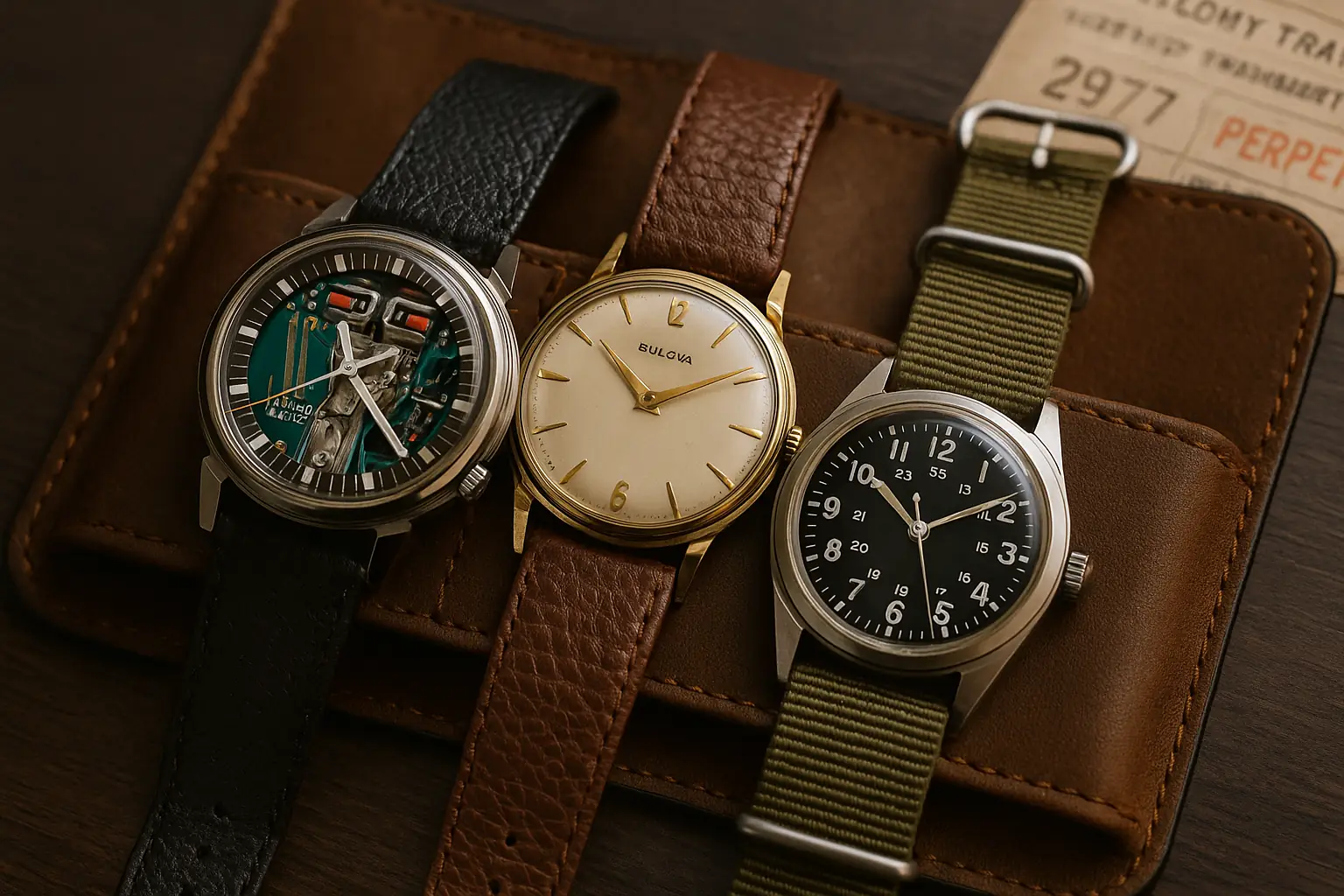
Bulova History & UK Connections
Bulova begins in New York in 1875, when Joseph Bulova, a Czech immigrant and trained jeweller, set up shop on Maiden Lane. By the 1910s and 1920s the firm had moved far beyond retail, pioneering standardised, interchangeable parts for watches at a dedicated factory in Biel/Bienne, Switzerland. That industrial approach, unusual at the time, meant repairable watches, consistent quality and, crucially, the scale to advertise nationally.
The brand became a marketing powerhouse. In 1926 Bulova sponsored the first radio time signal in the U.S.; in 1941 it aired what is widely cited as the world’s first television advertisement, a simple 10‑second bumper during a baseball game declaring “America runs on Bulova time.” For UK collectors, these milestones matter because they explain why Bulova achieved such wide distribution here by the 1930s: consumers recognised the name and trusted the promise of precision.
During the Second World War Bulova shifted capacity to military production wristwatches, aircraft instruments and timers. While the U.S. “A‑11” spec was made by several contractors, Bulova examples are well regarded for robust, easily serviceable movements and clear, luminous dials. Many pieces arrived in Britain with U.S. servicemen and stayed after the war, seeding the UK’s vintage supply. Post‑war British advertising emphasised waterproofing, shock‑protection (Incabloc and KIF types appear), and modern styling at approachable prices.
The brand’s technological peak came in 1960 with Accutron, the first commercially successful fully electronic wristwatch. Instead of a balance wheel, Accutron used a 360 Hz tuning fork regulated by a transistorised circuit. The fork’s constant vibration delivered accuracy within roughly a minute per month an order of magnitude better than most mechanical watches of the era. The distinctive hum and smooth sweep seconds hand became icons of the space age.
Accutron technology reached far beyond the wrist. Accutron timing units were used in aerospace, scientific instruments, and dashboard clocks; the U.S. space programme adopted Accutron components for timing tasks, and a Bulova chronograph prototype was famously worn on the lunar surface by Apollo 15’s Dave Scott. Back on earth, British jewellers marketed Accutron as the watch “for the age of electronics,” and UK buyers embraced both the futuristic design and the practical accuracy for business and engineering professionals.
Through the 1970s Bulova navigated the quartz revolution with hybrids such as Accuquartz (tuning‑fork with quartz regulation) and then full‑quartz ranges, while the Caravelle sub‑brand offered budget styling with Japanese movements. For the UK market, distribution ran through national chains (H. Samuel among them) and independent jewellers; gold‑filled U.S. cases were common, but you’ll also encounter UK‑hallmarked cases on certain models assembled for the local market.
Collector’s Tip: UK‑hallmarked cases indicate locally cased watches (often for tax/tariff reasons). You’ll see assay marks (e.g., London, Birmingham) and carat stamps on solid‑gold cases. Most U.S. market Bulovas are gold‑filled rather than solid gold learn to read the “10K RGP / 20 Microns / Gold Filled” language to avoid overpaying.
Model Families to Know
Bulova’s output is vast. The families below anchor most UK collections. For each, we note traits, what to check, and why collectors care.
1920s–1940s: Art Deco & Military
Art Deco (1920s–30s): Rectangular or tonneau cases, stepped bezels, engraved sides, stylised numerals, and enamel or two‑tone dials. Many are small by modern standards (28–32 mm), but remain historically rich and, in good condition, surprisingly wearable. Check for dial stability (no flaking), tight spring bars, and honest engravings.
Wartime/Military (1940s): Black or matte dials with luminous Arabic numerals, hacking seconds on many examples, sturdy screw‑back cases. Look for correct military engravings and matching hands. UK supply is decent, with values usually determined by dial originality and movement health.
1950s Dress & Early Waterproof
The 1950s brought slim, elegant references with applied indices and dauphine or alpha hands. Many are gold‑filled with crisp lugs; some stainless references appear for “waterproof” lines. These are unbeatable daily wearers if you prefer understated mid‑century design. Original signed crowns and period bracelets add value; over‑polish removes the shallow step lines that give these cases their charm.
Accutron 214 & 218 (1960s)
214 (1960–mid‑60s): Time set from the back (no side crown). Often in asymmetric, space‑age cases. Collectors seek correct index wheel, clean coils, and the proper handset. The smooth sweep seconds and quiet hum are the giveaways.
218 (from 1965): Adds a conventional crown at 3 o’clock, broadening appeal. The 218 family includes day/date and calendar variants. Ensure the crown action is positive and the calendar advances correctly, ham‑fisted repairs can cause damage.
Accutron Spaceview
Originally created as display demonstrators to showcase the tuning fork, the open‑dial “Spaceview” became so popular that Bulova released factory models. On genuine Spaceviews, the crystal, chapter ring, hands and case reference work as a set. Many standard Accutrons have been converted by removing the dial and adding an aftermarket crystal and ring.
Accutron Astronaut (GMT)
With a 24‑hour hand and rotating bezel, the Astronaut speaks to the jet age. Many UK examples show honest wear; original bezels and a strong, even lume are the value drivers. Replacement bezels exist check font weight and the look of the triangle marker. The Astronaut is among the most liquid Accutrons if originality is strong.
Oceanographer “Devil Diver” & Snorkel (late 1960s–70s)
The Oceanographer family, nicknamed “Devil Diver” for its 666‑ft rating delivers colour, presence and serious collector demand. Popular dials include deep black, sunburst blue/green, and the famed orange. Original bezels, signed crowns, and correct seconds hands separate the best examples. The related Snorkel line (including compressor‑case variants) offers similar appeal with different case architecture.
Accuquartz & the Quartz Era (1970s–80s)
Accuquartz bridged tuning‑fork heritage and quartz regulation; full quartz followed. These watches are historically important and currently excellent value. Focus on completeness (box, papers, bracelet) and clean dials good examples are under‑appreciated and make reliable daily wearers.
Caravelle
Launched in 1962 as Bulova’s budget line, Caravelle used reliable Japanese movements with Bulova styling cues. Early Caravelles include funky 60s/70s designs, divers‑style pieces and crisp dress watches. For new collectors, Caravelle is a smart, low‑risk path into the brand’s design language.
British‑Market Oddities & Retailer Signatures
From time to time you’ll encounter Bulovas with UK retailer signatures on the dial or caseback, and a smaller number with British‑made cases bearing assay marks. These cross‑over pieces attract both watch and social history collectors. As ever, condition and originality determine value verify fonts and stamping quality carefully.
What Drives Value
In any bulova watch vintage purchase, value resolves into five pillars: movement & tech, dial originality, case integrity, completeness, and provenance.
- Movement & tech: Tuning‑fork Accutrons (214/218), Astronaut GMTs and late‑60s divers are the top draws. Mechanical war‑era pieces also perform well if unmolested.
- Dial originality: Original dials with even, honest patina almost always outrank repaints. Redial tells include fuzzy fonts, lume blobs, or printing that “floats” above the lacquer.
- Case integrity: Crisp edges, intact brushing, sharp lug tips. Over‑polish erases value.
- Completeness: Box, papers, hang tags, and especially original bracelets create step‑changes in price for divers and dress watches alike.
- Provenance: Military engravings, retailer signatures and service records help you sell later and insure properly today.
Typical UK ranges (guide only): 1950s dress £200–£600; WWII military £450–£1,000; Accutron 214/218 (non‑Spaceview) £400–£1,200 depending on servicing; Spaceview £1,200–£2,800+ by originality; Astronaut £1,600–£3,000; Oceanographer/“Devil Diver” £1,000–£2,500 with bracelet premiums. Clean, fully documented outliers do sell higher.
Collector’s Tip: If you’re torn between two watches, choose the one with the better dial. Cases can sometimes be sympathetically refinished; original dials cannot be “re‑originalised.”
Authentication & Dating Guide
1) Case & Movement Date Codes
From 1950 onwards Bulova used a very friendly system: a letter for the decade + a digit for the year. L0–L9 = 1950–59; M0–M9 = 1960–69; N0–N9 = 1970–79; P0–P9 = 1980–89. Example: M6 denotes 1966. Many watches show the code on both caseback and movement ideally they align. A one‑ or two‑year difference can happen with service replacements, but major mismatches warrant questions.
2) Pre‑1950 Symbols
Before 1950 Bulova stamped small symbols on movements (and sometimes cases) to indicate the production year. You’ll see shapes like triangles, circles, squares and crescents. Because symbol charts vary by movement family and year, consult a dedicated reference such as MyBulova’s dating tables and compare several adverts from the suspected period.
3) Logos, Fonts & Lume
Logos and wordmarks evolve subtly by decade. Applied logos should sit level and crisp; printed scripts should have clean edges, correct spacing, and sit “in” the dial finish rather than on top. Lume chemistry follows the era: radium pre‑mid‑50s (often darkened), tritium afterwards (look for “T” or “T SWISS T” on some dials). Relumed plots can be too bright or sloppy.
4) Hands, Crowns, Crystals, Bracelets
Hand shapes and lengths are reference‑specific; minute hands should typically kiss the minute track; seconds hands clear all markers. Signed crowns appear on many 50s–70s watches correct style matters. Accutron crystals may have model‑specific chapter markings; diver crystals are often high‑domed acrylic. Bracelets are high‑impact value items: a correct “Bulova” signed bracelet can add 30–40% to a diver.
5) Spaceview Conversions – A Mini Checklist
- Does the case reference belong to a Spaceview configuration?
- Is the chapter ring printing era‑correct and aligned? (Many conversions use generic rings.)
- Do hands match verified factory sets for that case?
- Is the crystal correct (factory crystals often carry printed tracks/branding)?
- Does paperwork mention Spaceview, or is it a generic Accutron set?
Collector’s Tip: Photograph the movement in good light. Original coils are a bright copper tone; damaged or repaired coils can look scorched or patched. Index wheels are delicate, missing teeth mean trouble.
Buying in the UK
Britain is an excellent hunting ground for bulova watch vintage thanks to long‑standing retail channels and the country’s vibrant auction scene.
Auctions (specialist & regional)
Watch‑led auctions like Watches of Knightsbridge (London) and Fellows (Birmingham) routinely list Bulovas everything from 50s dress to Spaceviews and Devil Divers. Generalist houses across the UK also include Bulovas within mixed sales; track them via The Saleroom. Always read the buyer’s premium, VAT on premium, and shipping policies before bidding.
Dealers
Established vintage dealers provide vetting, return rights and after‑sales support, often with workshop backing useful for Accutron purchases. London has a cluster (Burlington Arcade and Mayfair), while independents nationwide offer curated stock; many transact online with inspection on appointment.
Fairs
The Birmingham NEC antique/watch fairs and London watch events are ideal for inspection in hand, which is especially helpful for dial originality and case geometry. Bring a loupe and a small LED torch; ask permission before opening casebacks.
Online Marketplaces
Chrono24 provides escrow and global choice; eBay UK has breadth but requires caution. Use Sold Listings to gauge realistic prices, and prefer sellers who show clear movement photos and accept returns.
Collector’s Buying Guide (Scenarios)
Scenario A: The First Bulova
You want a tasteful daily wearer under £500. Target a 1950s stainless or gold‑filled dress watch with an honest, original dial. Ask for a recent service or price accordingly for one (£150–£250). Avoid redials – learn the fonts and prefer signed crowns.
Scenario B: The Humming Accutron
Budget £600–£1,400 for a clean Accutron 218 or 214 (non‑Spaceview). Insist on evidence of recent specialist service or factor it in. Confirm battery solution (mercury cells are obsolete) and that regulation/phasing is correct. If you stretch to a Spaceview, study factory configurations before paying a premium.
Scenario C: The Devil Diver
Budget £1,200–£2,000+ depending on colourway and bracelet. Original bezel and hands are the big value levers. Many examples have moisture history; check for corrosion under the caseback and around the stem tube. Don’t dive with a 50‑year‑old watch; pressure testing is about case integrity, not swimming permission.
Scenario D: The Astronaut GMT
Budget £1,800–£3,000 for tidy examples. Confirm the bezel’s originality (font and pip), hand stack correctness and smooth operation. Paperwork is uncommon but a huge plus. Choose the best dial you can afford.
Scenario E: The Budget Back‑Up (Caravelle)
Budget £80–£250. Aim for funky 60s/70s designs with original dials; many run simple, reliable movements and are inexpensive to service. A great way to learn the Bulova look without risking much capital.
Negotiation Pointers: Bring comparable recent sales, ask for macro photos, and be polite but firm on redials or over‑polish deductions. Bundling a watch with its correct bracelet or a service commitment can unlock a better price.
Servicing & Restoration
Mechanical Bulova
Most 40s–70s mechanical Bulovas use robust ébauches with good parts availability. A proper full service includes disassembly, ultrasonic cleaning, replacement of worn components, lubrication, regulation and (for divers) a pressure test for integrity only. Expect £150–£250 at a competent independent. Avoid polishing unless a specialist can preserve geometry.
Accutron (214/218)
Accutrons are different: coils, index wheels and phasing require specific expertise. Ask outright if a watchmaker regularly services tuning‑fork Bulovas. The wrong battery or rough handling can toast expensive parts. A full service is typically £250–£400, more if parts are needed. Store Accutrons away from strong magnets, and remove batteries if the watch will sit for months.
Batteries & Power
Original mercury cells (1.35 V) are obsolete. Modern silver‑oxide cells (1.55 V) can work with proper regulation and, where needed, a voltage‑dropping solution. Never force‑fit lithium cells, and never “see if it works” on an unknown Accutron have it checked first.
Casework, Crystals & Water
Acrylic crystals on vintage Bulovas polish beautifully; deep cracks merit replacement with like‑for‑like profiles. Gaskets can be replaced, but assume vintage water resistance is non‑functional for swimming. Keep moisture away from open casebacks during inspection.
Collector’s Tip: Ask your watchmaker to return all replaced parts in a small bag. Even a worn signed crown or original crystal can help prove originality later.
Pitfalls & Red Flags
- Redials & reprints: Blurry or overly glossy printing, misaligned minute tracks, lume that looks new but sloppy.
- Over‑polish: Rounded lugs and washed‑out bevels are value killers. Compare case lines to advert drawings.
- Frankenwatches: Mismatched date codes (e.g., M6 case with N4 movement) without explanation, or mixed handsets from other references.
- Spaceview conversions: The most common trap. If you can’t verify the configuration, price it as a regular Accutron.
- Moisture & corrosion: Discolouration around hands/indices, rust on screws, green verdigris under crystals walk or negotiate hard.
- Unknown service on Accutron: A bargain Accutron can become expensive quickly. Budget for specialist attention unless proven serviced.
UK Market Outlook (2025+)
The UK audience for bulova watch vintage keeps broadening. Three dynamics stand out:
- Electronic horology tailwind: As collectors look beyond Swiss mechanical icons, Accutron’s story resonates. Genuine Spaceviews and tidy 214/218s with proof of recent specialist service look set to remain strong.
- Dive design demand: With mainstream dive watches climbing, Devil Diver and Snorkel models provide colour, heritage and wrist presence at a fraction of top‑tier Swiss prices. Correct bracelets and bezels are the scarcity points.
- Dress watch re‑rating: Sharp 1950s Bulovas remain comparatively undervalued. As buyers rediscover slim mid‑century design, the best untouched dials should tighten in supply.
Bulova’s modern reissues (including contemporary Oceanographer models) also act as gateways, pulling new eyes back to the originals. Expect continued cross‑collecting from mid‑century design enthusiasts, camera/hi‑fi collectors and vintage fashion communities who want era‑right wristwear.
References & Further Reading
Use these to deepen your knowledge and verify specifics before you buy:
- Bulova (Official) – brand heritage pages, modern reissues useful for side‑by‑side design context.
- Accutron (Official) – technical history, model stories, and the culture around tuning‑fork timekeeping.
- MyBulova – community‑run adverts, date code tables, model IDs and discussion threads; invaluable for Spaceview verification.
- NAWCC Forums – deep technical threads on Bulova and Accutron; ask for servicing referrals and parts advice.
- British Horological Institute (BHI) – find qualified UK watchmakers; training articles on servicing standards.
- WatchPro (UK) & Hodinkee – industry features and historical pieces on Bulova/Accutron; good for broader market perspective.
- Auctions & archives: Watches of Knightsbridge, Fellows, Bonhams, plus regional houses via The Saleroom.
- Museums: Science Museum (London) clock & watch galleries; British Horological Institute Museum (Upton Hall) for a day of pure horology.
- Books: Accutron: The Watch That Changed Time (Bulova/Accutron, brand history) and Gisbert L. Brunner’s Wristwatches: History of a Century’s Development for context.
- Video learning: “Wristwatch Revival” and other restoration channels great for seeing Accutron service steps and the delicacy of index wheels and coils.
Conclusion
Bulova sits at the crossroads of design and technical history. From crisply engraved Art Deco rectangles to the whisper‑quiet hum of Accutron, from colourful 60s divers to slim 50s dress pieces, the brand offers a complete vintage journey at attainable prices. If your goal is to collect bulova watch vintage in the UK with confidence, focus on originality, learn the date codes, and build relationships with specialists who can document servicing – especially on tuning‑fork models. Buy the best dial you can find, prize complete sets, and don’t be afraid to pass on problem pieces. Done right, you’ll end up with a collection that tells the 20th century’s story of precision, style and everyday utility on your wrist.
Leave a Reply