

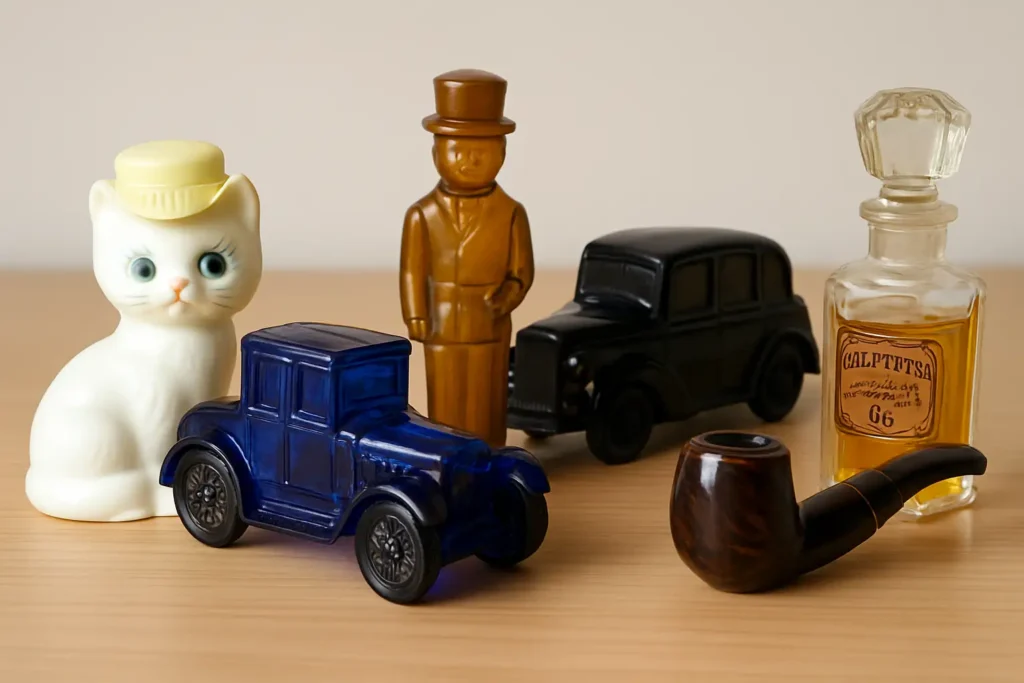
From nostalgic animal figurines to quirky car decanters, vintage Avon perfume bottles offer UK collectors a colourful route into perfume and glassware history. Their charm lies not only in the designs but also in learning how to verify authenticity, assess condition, and confidently judge value in today’s market.
Quick Summary
- Vintage Avon perfume bottles are decorative glass and novelty figural containers produced from the mid-20th century onwards, sold primarily through Avon’s well-known door-to-door representatives.
- Collectors value them for their nostalgic cultural links, playful mid-century design language, and accessible price point, though desirability varies significantly based on scarcity, design theme, completeness, and box condition.
- Authenticating and dating bottles involves examining base embossing, label typography, mould seams, packaging artwork, and known fragrance timelines – then cross-checking with reputable reference sources such as the International Perfume Bottle Association or Bud Hastin’s authoritative Avon guides.
- In the UK, typical price ranges include £3–£10 for common loose novelty bottles, £15–£40 for scarcer or boxed examples, and £50+ for early CPC-era pieces, full themed sets, or bottles that appear in stronger UK auction line-ups.
Brief History & Context
To understand why vintage Avon perfume bottles have become such a popular collecting niche in the UK, it helps to step back to Avon’s origins. The story begins not with the playful figural bottles of the 1960s and 1970s, but with the California Perfume Company (CPC), founded in 1886 by David H. McConnell in New York. Initially producing modest ranges of fragrances and toiletries, CPC built a direct-selling model centred around door-to-door representatives – a system that would later define the Avon brand worldwide.
In 1939, the California Perfume Company formally adopted the name Avon. Throughout the 1940s and 1950s, the brand expanded internationally, including into the UK, using a representative-led sales model that made cosmetics accessible to suburban households. Early Avon bottles were generally functional glass cologne and perfume containers, often with simple labels and modest decorative flourishes.
The turning point for collectors came in the mid-1960s, when Avon began producing increasingly imaginative and sculptural containers. These novelty “figural bottles” transformed fragrance into a decorative object: cars, animals, birds, clocks, chess pieces, telephones, ships, musical instruments and more. The first widely popular glass car decanter appeared around 1968 and rapidly became a bestseller, leading to dozens of variations and colourways throughout the following decades.
In the UK, Avon’s direct-sales structure integrated perfectly into post-war community life. By the 1970s and 1980s, the distinctive bottles were common gifts exchanged between family members, workplace colleagues and neighbours. Many were proudly displayed on dressing tables or bathroom shelves before eventually finding their way into cupboards, lofts and sideboards – where a great many still remain. Today, these rediscovered bottles have become objects of nostalgia, decorative charm and design history.
Why collectors love vintage Avon perfume bottles
- Nostalgia: Many UK collectors remember these bottles from childhood visits to relatives’ homes, making them emotionally resonant objects.
- Design variety: Avon’s catalogue spans everything from milk glass cats and owls to opaque glass Viking ships, classic cars and Victorian-style ladies.
- Low entry price: Compared with fine perfume bottles or antique glassware, Avon pieces are accessible for beginners.
- The thrill of the hunt: Spotting unusual colour variations, short-run designs or boxed examples at car boot sales and charity shops offers genuine excitement.
Key milestones for Avon bottles
- 1886: The California Perfume Company is founded, laying the foundations for what would become Avon.
Source - 1930s–1940s: The Avon name becomes established; fragrances are sold in simple glass bottles with modest decoration.
- Mid-1960s: Launch of decorative figural containers. Early animal designs and decorative glass pieces begin shaping Avon’s identity.
IPBA - 1968: Introduction of the first glass car decanter – a runaway success that inspires an entire category of vehicle-themed bottles.
Bud Hastin’s Encyclopedia - 1970s–1980s: Peak production era for themed bottles. Avon’s presence in UK households is at its strongest, with gift sets and novelty bottles becoming widespread.
- 1990s onwards: Avon shifts towards more standardised commercial packaging; the novelty era fades.
- 2000s–today: Serious collecting takes shape. Specialist reference books, online communities and perfume bottle associations begin cataloguing variations, production periods and rarer pieces.
IPBA UK Chapter
For UK collectors today, vintage Avon perfume bottles sit at a unique crossroads of design history, popular culture and everyday domestic memory. They reflect shifting tastes in home décor, gender roles, mid-century consumer trends and even automotive culture – all captured in glass, colour and fragrance. Whether displayed as themed sets or collected casually from charity shops and auctions, they remain one of the most approachable and culturally rich corners of the vintage perfume world.
Identification & Dating Guide
Most vintage Avon perfume bottles are not genuinely rare, but certain themes, limited runs, colour variations and boxed examples can be highly desirable to collectors. Accurate identification and rough dating allow you to understand what you’re holding, avoid overpaying, and spot the occasional gem hidden in a mixed lot at a UK auction, charity shop or car boot sale. For beginners, knowing what details matter – and what doesn’t – is the difference between building a thoughtful collection and accidentally buying lookalikes or mismatched parts.
Materials & Construction
Avon used a surprisingly wide mix of materials across decades. Understanding how these age, feel and present helps distinguish genuine period bottles from later decorative items or non-Avon figural glass often mistakenly attributed to the brand.
- Pressed glass:
The majority of novelty designs – especially cars, animals and everyday-object bottles – are made from pressed glass. Look for clear mould seams, even wall thickness, consistent colouring (amber, cobalt, emerald, clear), and a satisfying weight. Genuine Avon pressed glass tends to feel solid and well-finished, unlike cheaper contemporary reproductions. - Milk glass:
Many of the most loved figurines are opaque white milk glass. Authentic milk glass should be smooth, dense, slightly cool to the touch and subtly translucent at thinner edges when held against strong light. Chalkiness, uneven colour patches or unusual brightness can signal a later non-Avon decorative bottle. - Opaque & painted finishes:
Painted features (eyes, hats, trims, insignia) and enamelled highlights were common on 1960s–1980s bottles. Natural ageing includes mild rubbing on raised areas and soft wear on edges. Perfectly pristine paint on an otherwise worn bottle often indicates repainting or a reproduction. - Plastic components:
Screw caps, faux wheels, hats, helmets, and decorative tops were often made in plastic. Genuine plastics from the period usually show light mellowing, faint micro-scratches or a gentle satin finish. Ultra-glossy, perfectly new-looking plastics on an older glass body should raise questions. - Labels & paper:
Original Avon labels range from simple printed paper strips to metallic foils. They typically show mild yellowing, slight curling or gentle adhesive ageing. Perfectly white, bright, modern-looking labels are a red flag for replacements.
Measurements & tolerances:
Avon’s production was highly standardised. Most novelty bottles stand between 8–20 cm tall, with reliably consistent dimensions. Major deviations – mismatched tops, stretched proportions, uneven bases – often indicate married parts (tops paired with wrong bodies), heat distortion, or bottles incorrectly identified as Avon.
Marks, Logos & Packaging
The fastest route to identifying a vintage Avon bottle is to check the base, followed by label style and packaging. Many designs feature clear embossed branding, but not all do, especially in early or contract-made lines. A magnifying glass or smartphone macro mode can reveal subtle mould marks.
Typical identifiers include:
- Embossed “AVON” on the glass base – common on 1960s–1980s novelty runs.
- Moulded numbers or batch codes indicating production moulds rather than exact dates.
- Printed adhesive labels naming the fragrance, volume (oz, ml, or both), and sometimes ingredients.
- Original illustrated boxes matching the bottle’s shape, often with colourful artwork specific to that design.
Avon operated internationally with multiple production facilities, so wording and marks vary slightly by era and region. Dating by marks alone is rarely exact, which is why collectors rely on combined clues: label typography, fragrance availability dates, packaging artwork and comparison with established reference works such as
Bud Hastin’s Avon Collector’s Encyclopedia or resources from the International Perfume Bottle Association (IPBA).
Below is a simplified guide to common marks and their indicative production eras. Treat these as ranges – not fixed timestamps – and always cross-reference with specialist literature for accuracy.
| Mark / Feature | Approximate Years | Notes |
|---|---|---|
| Embossed “AVON” on base (no country) | c. mid-1960s–1980s | Typical of mass-produced novelty bottles, including cars, animals and character figures. |
| Base label “Avon Products, Inc.” (US address) | c. 1950s–1970s | Earlier export or US-market pieces; appear in UK collections via gifts, travel or imports. |
| Labels showing both ml & fl. oz. | c. 1970s onwards | Reflects international packaging standards; useful for distinguishing earlier vs later versions. |
| Country of origin (e.g., Brazil, Mexico, France) | c. 1970s–1990s | Indicates contract manufacturing. Common and not necessarily tied to rarity. |
| Bold illustrated cardboard boxes | c. late-1960s–1980s | Often significantly increases desirability when intact; some box artworks are collectables themselves. |
Dating Checklist
The following is a fast, under-60-second method for dating most Avon perfume bottles. It won’t provide an exact year, but it will usually place a piece within the correct decade and help you spot items worth deeper research.
- Check the base.
Look for embossed “AVON”, country names, mould numbers or batch indicators. Absence of any marking is a caution sign. - Read the labels.
Note fragrance name, volume units, typography and colour. Single-unit (oz only) labels often predate metric adoption; dual-unit labels usually indicate later production. - Assess the style.
Novelty cars, animals and whimsy designs almost always belong to the mid-1960s–1980s era. Sleeker, elegant bottles may be earlier or part of later commercial fragrance lines. - Check packaging.
Illustrated boxes with bold artwork strongly suggest the novelty-bottle peak period (1960s–1980s). Boxes with barcodes are typically later. - Look for paperwork.
Some boxed sets include mini catalogues, safety inserts or promotional leaflets. Fonts and imagery can offer valuable dating clues. - Cross-check the fragrance name.
Many Avon scents, such as Sweet Honesty or Moonwind, have well-documented release periods. Reference books and collector groups can help narrow these down. - Compare with completed listings.
Use sold items on eBay UK or archived catalogues from UK auction houses to confirm typical dating and descriptions.
This quick method won’t replace detailed reference work, but it will put most bottles into a sensible time frame and help you identify when a piece is potentially special.
Notable Makers, Marks & Variants
Unlike many antiques categories where multiple manufacturers compete across eras, vintage Avon perfume bottles come from a single brand: Avon Products. However, Avon’s output is so diverse – spanning automobiles, animals, historical figures, household objects and early California Perfume Company (CPC) designs – that collectors often group bottles into distinct “schools” or sub-types. These categories behave much like makers in traditional collecting fields, each with its own stylistic cues, rarity levels and value trends.
Understanding these sub-types helps collectors build themed displays, identify unusual variants, and avoid confusion with non-Avon decorative glass that frequently appears in UK charity shops and mixed auction lots. Below is a detailed breakdown of the most significant groups.
1. Animal & Figurine Bottles
Animal-themed bottles – cats, dogs, owls, birds, lambs and more – are among the most recognisable in the Avon back catalogue. They reflect 1960s–1970s mid-century taste for whimsical home décor and remain extremely popular with collectors of kitsch, cottage-core and retro interiors.
Several well-loved examples were paired with classic fragrances such as Moonwind and Sweet Honesty. These scents help narrow down production windows, as their availability periods are documented in reference works such as Bud Hastin’s Avon Collector’s Encyclopedia.
Key traits:
- Typically produced in milk glass or softly coloured opaque glass (pastel blues, greens, creams).
- Stylised features – wide eyes, exaggerated expressions, cartoon-like poses.
- Stoppers disguised as hats, bows, crowns or stylised fur/feathers depending on the theme.
- Values increase for crisp detailing, clean mould lines, intact painted accents and original boxes.
Because many animal bottles have cross-collecting appeal (cat collectors, owl collectors, mid-century décor enthusiasts), demand can outstrip general Avon interest, especially for well-preserved boxed sets.
2. Vehicle Decanters
Vehicle bottles form one of the most iconic and widely collected Avon categories. The very first glass car decanter released around 1968 became a surprise bestseller and led to decades of automotive-themed designs. These include vintage London taxis, sports cars, lorries, trains, steamships, motorbikes and more.
Key traits:
- Made from coloured pressed glass (amber, cobalt blue, green, smoky grey, clear).
- Often feature plastic wheels, grills or lids – components that are vulnerable to damage or loss.
- Some loosely evoke specific models (for example, early taxis or 1930s roadsters) without carrying brand trademarks.
- Collectors commonly seek complete sub-sets, such as all colour variants of a particular model.
Condition is critically important: chipped headlights, cracked plastic wheels or missing caps reduce value dramatically. Full boxed vehicle sets, especially those in excellent condition, consistently achieve some of the strongest prices in UK auction rooms.
3. Character & People Bottles
Avon’s character figurines include dancers, Victorian ladies, clowns, knights, flamenco performers, ballerinas and more. These designs often mirror the fashion aesthetics of the 1970s and 1980s, with flowing gowns, exaggerated collars, intricate hairstyles and pointed hats or accessories.
Key traits:
- Fine facial sculpting, drapery folds and small accessories such as fans or helmets are signs of higher-quality moulds.
- Late-run moulds sometimes show “softened” detail where repeated production wore down the definition.
- Many figures belong to themed series (e.g., Western, medieval, holiday collections), which can increase desirability when assembled as sets.
- Original boxes with photographic artwork rather than illustrated graphics often date to the later production period.
These bottles are particularly evocative of their era and are popular among collectors of costume history and theatrical memorabilia.
4. Everyday Object Bottles
Some of Avon’s most creative work came in the form of everyday objects reimagined as perfume or aftershave containers. Pipes, telephones, candlesticks, musical instruments, chess pieces, books and tools were all produced, mostly intended as masculine gifts and aftershave decanters.
- Witty, imaginative designs – a pipe may contain aftershave inside the bowl; a telephone may hide perfume under the receiver.
- Appeal extends beyond perfume collectors (e.g., chess collectors seek out chess-piece bottles).
- Protruding elements (antennae, horns, handles) are often the first to show damage.
Many collectors specialise solely in object bottles because their sculptural qualities make them excellent display pieces, especially in home bars, studies or retro-inspired interiors.
5. Early “California Perfume Company” (CPC) & Pre-Novelty Avon Pieces
Before the novelty era, Avon (through its predecessor, the California Perfume Company) produced simpler, elegant fragrance bottles. These early pieces appeal to advanced collectors due to their age, rarity and historical significance.
- Classic perfume forms with paper labels, delicate fonts and sometimes ornate glass stoppers.
- Often scarce in the UK, but do occasionally surface in antiques shops and estate sales.
- Complete examples with intact labels and original stoppers command significantly higher prices.
- Research is essential: identify through CPC catalogues, the IPBA, and specialist CPC history sites such as CaliforniaPerfumeCompany.com.
Because CPC bottles predate Avon’s mass-production moulds, variations can be greater and accurate dating requires cross-referencing multiple sources.
6. UK-Market & Regional Variants
Despite Avon’s global reach, regional distinctions exist. UK-market versions may feature dual metric/imperial measurements, English-only labelling, and packaging tailored to local sales campaigns. Some fragrances were sold only in certain regions or for limited promotional periods.
- UK-boxed examples sometimes differ in artwork, colour tone and typography from US counterparts.
- Some fragrances saw earlier or later release dates depending on the country.
- Contract manufacturing in Mexico, Brazil or Europe can appear on labels and help place bottles within specific production eras.
Advanced collectors often compare regional variants side-by-side, contributing research to collector forums and fragrance bottle associations. Auction archives, collector reference groups and marketplaces such as eBay UK can help identify which variants appear more commonly or rarely in the British market.
Condition, Grading & Restoration
Condition is one of the strongest determinants of value in the world of vintage Avon perfume bottles. Although these bottles were mass-produced and intended for everyday domestic use, collectors today place a premium on examples that remain clean, undamaged and as close as possible to their original presentation. For many designs, the difference between a £5 bottle and a £40 bottle is simply condition and whether the original box has survived.
Because Avon items were often stored for decades in lofts, dressing tables and bathroom cabinets, minor wear is entirely normal. The key is learning what counts as acceptable ageing and what significantly harms collectability.
Suggested Grading Scale
Although Avon collectors do not use one universal grading standard, UK dealers and enthusiasts tend to follow a flexible but widely understood scale:
- Mint in Box (MIB):
Bottle, stopper and label are near-perfect with virtually no signs of handling. Box is crisp with clean edges and unfaded artwork. Original contents may still be present (even if partially evaporated). These examples typically sit at the very top of the market for most designs. - Near Mint:
Excellent overall condition with only the lightest wear from storage. Labels are intact and bright; plastic elements show no cracks. Box may be absent or show minor shelf wear. - Very Good:
Light rubbing to high points, small label wear, or tiny base-edge fleabites that don’t detract on display. Glass is clean and structurally sound. - Good / Display Worthy:
Noticeable wear, rubbing, or small chips visible on inspection but still solid for shelf display. Plastic elements may show age-related stress or slight discolouration. - Poor / Damaged:
Cracks, broken stoppers, significant label loss, mismatched tops or missing parts. These items are usually suited to upcycling, craft use or as placeholders in a themed collection.
For rare designs, collectors may accept lower-grade examples, but for common bottles, condition is everything. A pristine box alone can sometimes double the value of an otherwise ordinary piece.
Perfume, Evaporation & Odour
Original contents divide opinion among collectors: some appreciate the authenticity of a bottle retaining its vintage fragrance, while others prefer the cleanliness of an empty vessel. Over time, perfume naturally evaporates or oxidises, often darkening into a syrupy residue that smells musky or rancid. This ageing is normal and not a sign of poor storage.
Be cautious with “full” bottles. Some sellers top up half-empty bottles with modern fragrance or tinted liquid to create the impression of originality. If you are paying a premium for contents, ask:
- When was the bottle last opened?
- Has the seller verified that the remaining contents are original?
- Are there clear photos of the liquid’s colour, fill level and cap?
Serious collectors treat fragrance level as a secondary factor: it can add interest, but it should never outweigh structural condition and completeness.
Cleaning: Do and Don’t Checklist
Gentle cleaning preserves value; heavy-handed cleaning harms it. Here’s what collectors recommend:
- Do dust with a soft brush or microfibre cloth to avoid micro-scratches.
- Do use lukewarm water and a tiny amount of mild washing-up liquid on sturdy glass only.
- Do protect labels by keeping them dry at all times – moisture permanently damages original paper.
- Do support stoppers and plastic caps; many cracks occur when these are handled as lifting points.
- Don’t soak paper labels, foil labels or cardboard boxes – water will permanently wrinkle or detach them.
- Don’t use abrasives, metal scourers, chemical solvents or acetone on painted or enamelled bottles.
- Don’t attempt to sand, polish or “improve” mould seams – these seams are part of the original manufacturing process.
- Don’t over-clean: many collectors prefer a gently aged look over an overly shiny, unnatural finish.
If in doubt, test on an inconspicuous area first or consult experienced collectors via online groups or specialist associations such as the
International Perfume Bottle Association (IPBA).
Restoration & Ethical Disclosure
Some restoration is acceptable, even advisable: removing adhesive residue, carefully cleaning old perfume deposits, or repairing a clean break in a plastic component can improve display quality. However, heavy restoration – repainting figurines, removing mould seams, filling chips, or creating replica labels – can mislead future buyers and is discouraged.
Ethical transparency is essential. If you restore a bottle and choose to sell it, disclose precisely what was done. Not only is this ethical practice, but transparent sellers quickly build trust in the UK collecting community and often see higher repeat sales.
Storage Environment
- Keep bottles out of direct sunlight to avoid fading of painted details, labels and coloured glass.
- Avoid extreme temperature fluctuations; lofts and garages are rarely ideal for long-term storage.
- Store original boxes upright and avoid placing heavy items on top to prevent crushing.
- For display, consider a cabinet with UV-filtering glass or position shelves away from strong window light.
- Ensure a dry, steady environment – dampness encourages mould on boxes and corrosion on metal components.
With proper care and storage, vintage Avon perfume bottles remain stable, attractive and highly collectable for decades. Many UK collections today include bottles that have survived in excellent condition since the 1960s thanks to careful handling – a testament to both their durability and the value collectors place on preservation.
Fakes, Reproductions & Red Flags
Compared with designer perfumes, art glass or high-end vanity bottles, vintage Avon perfume bottles are not commonly counterfeited in a sophisticated way. However, the real risk lies in misattribution, optimistic selling tactics and misleading presentation. Because Avon’s novelty bottles share similarities with many other mid-century figural glass products, it’s easy for non-Avon pieces – or altered Avon bottles – to be passed off as something more valuable than they are.
Below are the most frequent issues UK collectors encounter, along with practical checks to keep your purchases authentic and fairly priced.
- Non-Avon figural bottles sold as Avon:
Many companies in the 1960s–1980s produced whimsical bottles, including decorative aftershave decanters and novelty cologne containers. If a bottle lacks any Avon embossing, label or packaging and the style feels slightly “off” compared to documented Avon designs – treat it as non-Avon. Cross-checking with reference works such as Bud Hastin’s Encyclopedia or the IPBA catalogue avoids costly mistakes. - Home-made or replacement labels:
Sellers occasionally add reproduction labels to “complete” a bottle. These are often easy to spot: modern printer-white paper, crisp laser-cut edges, glossy surfaces or fonts that look contemporary rather than mid-century. Genuine Avon labels show age-appropriate patina: slight yellowing, softer edges and gentle adhesive ageing. - Repainted or heavily touched-up decoration:
Avon’s factory-applied paint was subtle and prone to gentle wear over decades. Overly bold colours, glossy finishes, thick brush strokes or sloppy detailing suggest repainting. Repainted bottles are acceptable as decorative items but have significantly reduced collectable value and should always be disclosed. - Suspiciously “full” bottles:
Evaporation is normal in bottles that are 40–60 years old. A bottle filled to the neck – especially when the fragrance looks unusually bright – may have been topped up with modern perfume, coloured oil or even water. If “fullness” is being used to justify a higher price, request close-up photos of the liquid colour, fill line and cap interior. - “Extremely rare” claims for common designs:
Many Avon bottles were produced in enormous quantities. Car decanters, milk-glass animals and character bottles often appear weekly in UK auctions and online marketplaces. A quick check of eBay UK’s completed listings usually reveals whether a design is actually rare. - Mismatched tops and bases:
One of the most common issues in the UK second-hand market. Stoppers may be lost and replaced with visually similar pieces. Check colour match, fit, mould style and finish. A cap that sits awkwardly or uses a different plastic mould is a sign of a “marriage”.
Other Red Flags to Watch For
- No base embossing where one should exist: Most mid-1960s–1980s novelty bottles include some base marking, even faintly.
- Poor mould detail: Excessively soft or unclear sculpting may indicate a non-Avon novelty bottle rather than wear from age.
- “Prototype” or “dealer sample” claims: These are extremely unlikely for Avon and are almost always unfounded.
- Unusually bright or modern colour tones: Avon rarely used neon or metallic finishes on figural glass.
How to Protect Yourself When Buying
- Compare with confirmed examples via reference books, Avon catalogues or collector groups.
- Check multiple UK price points (eBay, Etsy, auction houses) before believing rarity claims.
- Ask for base photos, stopper photos and box photos before committing to a purchase.
- Use reputable sources – established dealers, recognised UK auction houses and perfume bottle associations.
In practice, the biggest danger lies not in sophisticated fakes but in overpaying for very common pieces. A little research, visual comparison and price awareness will keep you safely grounded and help you spot genuinely interesting finds.
Buying Guide (UK)
The UK is an excellent hunting ground for vintage Avon perfume bottles. Avon’s strong presence throughout the mid-to-late 20th century, combined with today’s thriving second-hand market, means collectors at every budget level can find worthwhile pieces – from £1 charity shop finds to boxed rarities in curated auction catalogues. Knowing where to look, how to verify listings and how to judge price fairness will dramatically improve your success rate.
Where to Buy
- Online marketplaces:
eBay UK and Etsy are the most active online sources for single bottles and mixed lots. Use completed listings or “sold” filters to see what pieces actually sell for – not just optimistic asking prices. This gives the clearest picture of real UK market value. - UK auction houses:
Many general and collectors’ auctions include Avon bottles, often in mixed glassware or vanity lots.
Prices range widely: shelves or trays of assorted vintage Avon bottles often hammer between £20–£120, depending on quantity, condition and whether any scarcer designs or boxed examples are included. Check regional auctioneers such as The Saleroom or Easy Live Auction. - Antiques centres & vintage shops:
Many UK antiques centres keep a shelf or cabinet of Avon bottles, often grouped by theme (vehicles, animals, characters). Prices are usually mid-range: higher than car boots, lower than premium online listings.
These shops are ideal for inspecting condition in person. - Car boot sales & charity shops:
Still one of the richest sources of affordable Avon pieces. Expect prices from £1–£5 for common bottles and £5–£20 for boxed examples. Knowledge is key – interesting rarities do appear among bric-a-brac, especially in rural boot sales. - Perfume bottle fairs & collector events:
Specialist perfume bottle fairs, including events supported by the International Perfume Bottle Association (IPBA) and the IPBA UK Chapter,
offer access to rarer bottles, expert advice and curated displays. Excellent for networking and improving your identification skills. - Online collector groups:
Dedicated Facebook groups, forums and Discord communities often include “for sale” threads, identification help and collector-to-collector swaps. These communities are especially helpful when verifying unusual variants or regional releases.
Negotiation & Provenance
Avon bottles rarely require formal provenance in the museum sense, but understanding where and how the piece was stored can help you assess its value. When buying from a dealer or private seller – especially online – consider asking:
- “Is this from your own collection or a house-clearance lot?”
House-clearance finds can be untouched, but also more likely to have loft or damp-related wear. - “Has anything been repaired, repainted or replaced?”
Give sellers room to be honest; many will disclose issues when asked directly. - “Can you show close-ups of the base, label and any flaws?”
Close-ups often reveal details (or problems) not visible in general listing photos. - “Does it come with its original box or inserts?”
Box condition can dramatically elevate value; ask to see all sides if buying online.
For higher-value pieces – early California Perfume Company bottles or rare boxed sets – provenance matters more. Auction catalogues, estate labels and old collection records can help support insurance valuations or confirm authenticity.
Pricing Psychology
Knowing why some bottles command higher prices helps you navigate the market confidently. Value drivers include:
- Scarcity:
Common designs (e.g., certain car decanters or milk-glass animals) appear frequently. Limited-run colours, regional variants or early runs are more desirable. - Condition & completeness:
A boxed example in excellent condition can fetch 2–5× the price of the same bottle loose with label wear. - Cross-collecting appeal:
Bottles that appeal to multiple niches – e.g., a ship bottle wanted by maritime collectors as well as Avon enthusiasts – often achieve stronger prices. - Display impact:
Larger, sculptural designs or complete colour sets create impressive displays and attract premium interest. - Nostalgia factor:
Some designs evoke universal recognition. When several bidders “had that one growing up,” competitive bidding increases dramatically.
As a rule of thumb: an original box in very good condition often doubles or even triples value on common bottles and can elevate mid-tier pieces into the “collectable” bracket.
Values & Price Ranges
Prices for vintage Avon perfume bottles in the UK vary considerably depending on design rarity, condition, completeness, fragrance line, and current market interest. While these mass-produced items will never compete financially with rare Lalique or Art Deco vanity bottles, the Avon category offers accessible entry points, strong nostalgia appeal and, in some cases, steady value growth – especially for boxed examples, early California Perfume Company pieces, and themed sets that display well.
The ranges below reflect typical UK prices based on aggregated marketplace data (including sold/completed listings), observations from antiques centres, and hammer prices reported by regional auction houses. They should be treated as guidelines, not fixed rules.
Indicative UK Price Bands for Vintage Avon Perfume Bottles
These estimates assume average-sized bottles (8–20 cm), standard fragrances, and representative condition. High-grade boxed examples, unusual colour variants, prototypes (rare) or early CPC designs may sit well outside these bands. UK auction competitiveness, photography quality, and seasonality can also influence results.
Entry Level: Common Loose Bottles (£3–£10 each)
- Typical examples: Common car decanters (e.g., basic 1970s roadsters), milk-glass cats or owls, familiar 1970s–1980s animals, and unboxed character figures.
- Condition: Usually good but not perfect. Minor label wear, lightly rubbed painted details, and tiny fleabites are common. Caps may show age-related discolouration.
- Best for: New collectors building a varied display, decorators seeking colourful retro accents, or anyone assembling large themed shelves cheaply.
Mid Tier: Boxed or Scarcer Themes (£15–£40 each)
- Typical examples: Well-preserved animals with boxes (e.g., boxed doves, foals, lambs), interesting vehicle designs, and character figures from themed ranges such as knights, flamenco dancers or Victorian ladies.
- Condition: Very good to near mint. Boxes structurally sound with light shelf wear; labels intact; no major cracks or chips; paint mostly original.
- Best for: Collectors refining a focus (vehicles, animals, CPC-era pieces) and seeking display-ready examples with collectible packaging.
Upper Tier: Rare Designs, Early Pieces & Strong Groups (£50+)
- Typical examples: Early California Perfume Company bottles (pre-Avon), fully boxed thematic sets (e.g., chess pieces, car collections), unusual colour variants, limited promotional releases, and high-quality grouped lots offered through reputable UK auction houses.
- Condition: Excellent to mint; crisp labels; original stoppers; bright boxes with strong edges. For CPC bottles, legible labels and intact stoppers greatly increase value.
- Best for: Experienced collectors, those building exhibition-worthy displays, or buyers seeking higher-value historical examples that rarely surface in general second-hand markets.
The Avon market is shaped heavily by photography and presentation. A well-lit, clearly photographed boxed bottle can achieve a premium online, whereas the same item photographed poorly or sold in an uncurated job lot might achieve only a fraction of its potential. Similarly, grouped lots sold at the right auction house – especially those specialising in collectors’ sales – often outperform expectations.
Rarity also fluctuates across the UK: some bottles are common in northern house-clearance lots but scarce in southern antiques centres, and vice versa. Monitoring prices across eBay UK’s completed listings and regional auction archives via The Saleroom helps build an accurate sense of current market conditions.
Care, Storage & Insurance
With sensible handling and good storage habits, vintage Avon perfume bottles are surprisingly robust. Most were manufactured for everyday domestic use, so the glass itself is durable. The real vulnerabilities are labels, painted details, boxes and any remaining fragrance residue. A little preventive care goes a long way toward preserving both aesthetic appeal and long-term value.
Preventive Care
- Handling:
Always lift bottles by the main glass body, never by the stopper or plastic cap. These components can loosen over time and are especially vulnerable on novelty shapes.
For vehicle designs, avoid gripping fragile protrusions such as chimneys, masts, funnels, wheels or bumpers. - Cleaning agents:
Use mild washing-up liquid mixed with lukewarm water for the glass only. Keep labels, boxes and painted surfaces completely dry.
Avoid bleach, acetone, solvent-based cleaners, antibacterial sprays and any abrasive pads – all can remove paint, fog the glass or strip labels. - UV protection:
Position displays away from direct sunlight, which can fade coloured glass, wash out label printing and degrade cardboard box artwork.
If displaying in a cabinet, consider UV-filtering glass or at least place the cabinet opposite, not facing, bright windows. - Spill management:
If a bottle with remaining contents leaks, promptly wipe the glass to prevent sticky build-up. Old perfume oxidises quickly and attracts dust; remove residue gently with a lightly dampened cloth (avoiding labels).
Storage Options
- Wrap each bottle individually in acid-free tissue paper or soft cotton cloth. This prevents abrasion and protects painted details.
Bubble wrap can be used for glass but should never touch labels directly. - Store bottles upright in sturdy lidded boxes with dividers. Avoid tight packing – pressure on protruding shapes (such as wheels or animal ears) increases breakage risk.
- Keep original Avon packaging separate from adhesives, bubble wrap and newspaper ink. Acid-free archival sleeves or small cardboard inserts protect fragile box panels.
- Choose a cool, dry space such as a cupboard or under-bed storage.
Avoid lofts, garages and sheds, which suffer from humidity fluctuations, frost and heat – ideal conditions for mould, label deterioration and box warping.
Insurance & Documentation
Most UK household contents insurance automatically covers smaller collections, including groups of vintage Avon bottles. However, limits usually apply to collections over a certain value or to individual items exceeding specific thresholds. As your collection grows – or if you acquire rarer CPC-era bottles – it’s worth reviewing your policy.
- Photograph your collection:
Capture each bottle clearly from multiple angles, or photograph entire shelves for ease. Include details such as labels, bases and boxes. - Keep a simple inventory:
Note purchase dates, locations, prices paid and any distinguishing characteristics. A spreadsheet or note-taking app works perfectly. - Retain documentation:
Store auction invoices, dealer receipts, online order confirmations and any appraisal certificates. - Discuss specialist cover if needed:
If your collection includes higher-value perfume bottles beyond Avon – such as antique vanity bottles or early CPC designs – consider seeking a valuation from a perfume bottle specialist or a UK auction house with relevant expertise. The International Perfume Bottle Association and leading UK auctioneers can offer guidance on professional appraisals.
Proper documentation not only protects you in case of loss but also simplifies future sales, estate planning or insurance claims. Even a modest Avon collection benefits from clear records and good care habits.
Legal & Ethical Considerations
Most vintage Avon perfume bottles are uncomplicated from a legal and ethical standpoint, but collectors who buy, sell or ship regularly – particularly across borders – should keep a few key points in mind. These considerations help protect you, your buyers and the integrity of the collecting community.
- Flammable contents & postage:
Perfume and aftershave are classified as flammable liquids. UK postal services, including Royal Mail, have strict rules regarding shipping liquids containing alcohol, especially internationally. If sending bottles that still contain fragrance, check the most recent guidelines for packaging, volume limits and declaration requirements. - Cosmetic safety:
Vintage perfume is collectible, not a cosmetic product intended for use. Ingredients, allergens and safety standards have changed significantly since the 1960s–1980s.
Avoid implying that old contents are suitable for regular personal use – this could raise safety and liability concerns. - Trademarks & branding:
Avon retains intellectual property rights to its brand names, logos and trademarks.
Selling genuine vintage bottles is completely acceptable, but creating new bottles, labels or packaging using Avon branding is prohibited and potentially infringing. - Cultural sensitivity:
Some older Avon designs or marketing materials reflect dated cultural stereotypes or themes. When showcasing these items, consider framing them within their historical context rather than presenting them uncritically. - Sustainability:
Collecting vintage Avon perfume bottles is an inherently sustainable form of re-use.
Where possible, avoid binning damaged or incomplete but historically interesting pieces. Instead, consider donating them to educational displays, craft reuse groups or museums with study collections (with full disclosure of condition).
Books, Museums & Resources
Research is one of the real pleasures of collecting vintage Avon perfume bottles. The following books, online archives and organisations provide essential identification support, historical insight and community connections for both new and advanced collectors.
- International Perfume Bottle Association (IPBA)
– A global organisation dedicated to perfume bottle scholarship and collecting. Offers educational resources, identification help, collector events and member exhibitions. An authoritative source for all perfume-bottle-related study. - IPBA UK Chapter
– A valuable hub for UK collectors featuring event listings, meetings, fairs and opportunities to connect locally with other enthusiasts. Particularly useful for UK-specific dating questions and finding regionally distributed variations. - Bud Hastin’s Avon Collector’s Encyclopedia
– Widely regarded as the most comprehensive reference guide on Avon and California Perfume Company products. Features photographic catalogues, dating tips, fragrance lists and production notes. Essential for serious collectors. - California Perfume Company Collector’s Tips
– A specialised resource offering guidance on identifying early (pre-Avon) perfume bottles, understanding labels, and recognising CPC-era colourways. Ideal for those interested in the earliest and most historically significant pieces. - Avon Bottles – A Beginner’s Guide to Collecting
– An accessible introductory article outlining the core themes of Avon bottle collecting, with emphasis on condition, dating and navigating online marketplaces. A helpful starting point for new collectors.
UK museums with decorative arts or glass collections – such as the Victoria and Albert Museum, the National Museum Cardiff, or the Glasgow Museums – often include perfume bottles within their archives, though Avon examples may not always be on public display. Reaching out to collections staff or browsing online catalogues can reveal relevant pieces and provide broader context for your own collection.
FAQs
- How do I quickly tell if a vintage Avon perfume bottle is authentic?
- You can usually confirm authenticity in under a minute using three core checks:
- Base marking:
Look for an embossed “AVON” on the glass base or a genuine printed label.
While not every bottle carries a mark, most mid-1960s–1980s novelty designs do. - Material & weight:
Authentic Avon bottles feel solid – typically pressed glass or milk glass with crisp moulding.
Very lightweight plastic or thin, hollow-feeling figures without any branding are unlikely to be genuine. - Design match:
If you have a smartphone, search the design name plus “Avon bottle” or compare with references on reputable sites such as the International Perfume Bottle Association or the digital version of Bud Hastin’s Encyclopedia.
- Base marking:
- What affects value the most?
- For most collectors, these factors have the greatest impact on price 0 roughly in order:
- Condition & completeness: Clean glass, crisp details, intact labels and original stoppers/caps matter hugely. An original box in good condition can multiply value several times.
- Design popularity & scarcity:
Certain themes – unusual animals, specific vehicle shapes, character figures or early CPC bottles – attract higher demand. - Presentation quality:
Clear, well-lit photographs and accurate descriptions significantly increase resale prices compared with dim or cluttered listings. - Provenance & grouping:
Sets sourced from a long-held, well-cared-for collection or sold as coherent themed groups often command premiums.
- Where can I get an appraisal in the UK?
- For everyday Avon bottles, researching completed listings on eBay UK often provides a realistic sense of value.
For larger collections or scarcer early pieces, try:- Antiques & collectors auction houses:
Many UK auctioneers offer free valuation days or online valuation forms. They frequently handle mixed perfume bottle lots and can provide estimated hammer ranges. - Perfume bottle associations:
The International Perfume Bottle Association and the IPBA UK Chapter can help direct you to specialist members familiar with Avon, CPC-era bottles and broader fragrance history. - Specialist dealers:
Some vintage perfume, vanity-item or retro glassware dealers offer written valuations suitable for insurance purposes or private sale.
- Antiques & collectors auction houses:
Glossary
- Avon representative (“Avon lady”) – A door-to-door salesperson central to Avon’s mid-20th-century business model. Representatives demonstrated products, took orders and built local customer networks that helped Avon become a household name across the UK.
- California Perfume Company (CPC) – The original name of the company founded in 1886 that later became Avon Products. CPC-era perfume bottles (often simpler, earlier glass designs with paper labels) are sought after by advanced collectors.
- Decanter – In the Avon context, a decorative bottle or container designed to hold perfume or aftershave, frequently shaped as cars, animals, household objects or novelty figures. Many decanters were intended as giftware.
- Figural bottle – A bottle designed in the shape of a person, animal, vehicle or other representational form rather than a standard geometric shape. Figural bottles make up a major part of Avon’s collectable output.
- MIB (Mint in Box) – A condition grade meaning the bottle and original packaging are in near-perfect condition with minimal signs of handling. Often commands a premium in the UK market.
- Patina – The natural signs of age that develop on vintage items over time, such as mild surface wear or gentle toning on labels. Patina can add authenticity but heavy wear reduces value.
- Provenance – The recorded chain of ownership of an item. While not essential for everyday Avon bottles, provenance can support value for early CPC pieces or high-end thematic sets.
- Stopper – The part that seals a bottle’s opening, made from glass or plastic and often shaped as part of the bottle’s overall design (e.g., a hat, wheel, animal head). Missing or mismatched stoppers lower value.
- Job lot – A group of items sold as one combined lot, common in UK auction houses and car boot sales. Job lots can offer excellent value if they contain multiple boxed or unusual Avon designs.

